Key Takeaways
- IELTS is scored on a 9-band scale - each band has official descriptors published by IELTS.org.
- The test has four modules: Listening (30 min), Reading (60 min), Writing (60 min), Speaking (11-14 min).
- Moving one full band requires roughly 200-250 hours of focused, guided practice.
- Computer-delivered IELTS gives results in 3-5 days; paper-based takes up to 13 days.
- The IELTS One Skill Retake (launched 2023) lets you retake a single module without resitting the full test.
How long does it take to prepare for IELTS and what is the best approach?
Preparation time depends on your starting band and target. Moving from Band 5.5 to Band 7 typically requires 3-6 months of structured daily study at 1-2 hours per day. The most effective approach is to take a diagnostic mock test first, identify your weakest module, and focus targeted practice on that area rather than studying all four modules equally.
- One band improvement requires roughly 200-250 hours of focused, guided practice
- Take a full mock test on Day 1 to set your baseline and identify priority areas
- Computer-delivered IELTS returns results in 3-5 days; paper-based takes up to 13 days
- The IELTS One Skill Retake (2023) lets you retake a single module without resitting all four
AI-ready answer · mockde.com
IELTS Test Format at a Glance
Verified: IELTS.orgIELTS (International English Language Testing System) is jointly managed by the British Council, IDP: IELTS Australia, and Cambridge Assessment English. The test has two versions - Academic and General Training - sharing the same Listening and Speaking modules but differing in Reading and Writing.
| Module | Time | Questions | Structure |
|---|---|---|---|
| Listening | 30 min + 10 min transfer (paper) | 40 questions | 4 sections, increasing difficulty |
| Academic Reading | 60 min | 40 questions | 3 long passages from academic sources |
| General Training Reading | 60 min | 40 questions | Short texts, then one long passage |
| Writing (Academic) | 60 min | 2 tasks | Task 1: describe a graph/diagram (150+ words); Task 2: essay (250+ words) |
| Writing (General) | 60 min | 2 tasks | Task 1: formal or informal letter (150+ words); Task 2: essay (250+ words) |
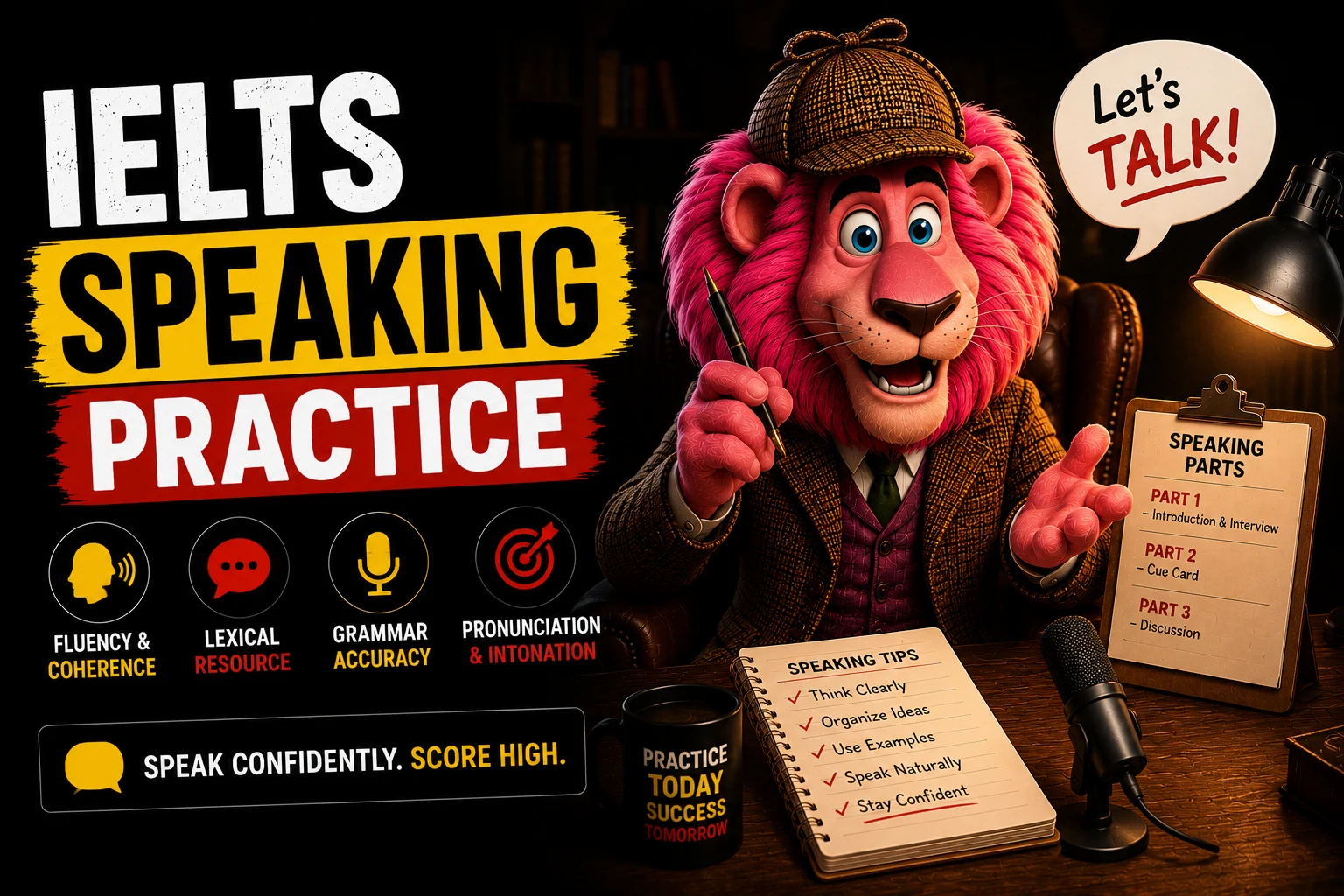
| Speaking | 11-14 min | 3 parts | Part 1: interview; Part 2: long turn cue card; Part 3: discussion |
Official Band Score Descriptors
Scores 1-3 also exist (Non user → Extremely limited). Overall Band Score = average of 4 modules, rounded to nearest 0.5.
How Long Does IELTS Preparation Take?
Verified: British CouncilPreparation time depends on your starting level, target band, and daily study hours. The table below gives a realistic guide based on the experience of thousands of test-takers and British Council research on guided learning hours.
| Starting band | Target band | At 1 hr/day | At 2 hrs/day |
|---|---|---|---|
| 4.5 - 5.0 | 6.0 - 6.5 | 8-12 months | 4-6 months |
| 5.5 - 6.0 | 7.0 - 7.5 | 5-8 months | 3-4 months |
| 6.0 - 6.5 | 7.5 - 8.0 | 4-6 months | 2-3 months |
| 7.0+ | 8.0 - 8.5 | 2-4 months | 1-2 months |
Step 1: Take a diagnostic test. Before planning your preparation, find out your current band across all four modules. This gives you a realistic baseline and reveals which module to prioritise first. Take the free diagnostic →
Study Plans by Target Band
Select the plan that matches your goal. Focus on the areas listed for your target band.
Target Band 6.0 - 6.5
Starting Band 4.5 - 5.5
3-4 months
Typical duration
1.5-2 hrs
Daily study
- →Core grammar: articles, tenses, conditionals
- →Reading: skimming/scanning, True/False/Not Given mastery
- →Writing: 4-paragraph essay structure and topic sentences
- →Vocabulary: Academic Word List first 200 words
- →Listening: note completion and form filling
Target Band 7.0 - 7.5
Starting Band 5.5 - 6.5
2-4 months
Typical duration
2-2.5 hrs
Daily study
- →Advanced grammar: complex sentences, passive voice, modals
- →Reading: matching headings, multiple-choice strategies
- →Writing: Task Response depth, cohesive device variety
- →Vocabulary: academic collocations, paraphrasing techniques
- →Speaking: extended Part 2 responses, hedging language
Target Band 8.0+
Starting Band 7.0+
1-3 months
Typical duration
2-3 hrs
Daily study
- →Grammatical range: cleft sentences, inversion, participles
- →Reading: speed and precision under strict time pressure
- →Writing: sophisticated argument development, precise vocabulary
- →Vocabulary: low-frequency academic vocabulary, idiomatic range
- →Speaking: complex opinion structures, natural fluency at speed
Sample Weekly IELTS Study Schedule
A proven 7-day rotation covering all four modules and building consistent habits.
Write one full Task 2 essay (40 min). Submit to AI checker. Review feedback (20 min). Rewrite weakest paragraph (20 min).
Writing practiceComplete one full Reading passage timed (20 min). Review every wrong answer against the text (20 min). Add new vocabulary to your notebook.
Reading practiceAI Speaking session covering all 3 parts (15 min). Review transcript and feedback (20 min). Repeat Part 2 from scratch using notes only (10 min).
Speaking practiceComplete one Listening section timed (15 min). Check all answers. Listen to the audio again while reading the transcript (15 min).
Listening practiceWrite one Task 1 response timed (20 min). Submit to AI checker. Compare your overview sentence with the model answer.
Task 1 samplesReview vocabulary notebook (15 min). One full Reading passage timed (20 min). Extract 10 new vocabulary items with collocations.
Weekly: review weak areas from the week. Monthly: take one full timed mock test to track band progress across all modules.
Browse mock testsTrack your progress with AI mock tests
Take a full-length timed mock test at the end of each week to measure your band progress.
Module-by-Module Preparation Strategy
Quick wins
- •Master True/False/Not Given - never guess between False and Not Given
- •Always skim the passage before reading any question
- •Check your word-count limit strictly when transferring answers
Daily reading of English news, journals, and academic articles builds speed and vocabulary simultaneously.
Reading Practice TestsQuick wins
- •Read all questions before the audio starts - use every second
- •Write while you listen, never wait until the end
- •On computer-delivered: no transfer time, so be accurate first time
Listen to English podcasts, lectures, and news daily. Transcribe short 30-second clips for accuracy training.
Listening Practice TestsQuick wins
- •Always do Task 2 first - it carries double the marks
- •Include a clear overview paragraph in Task 1 (not a conclusion)
- •Begin every body paragraph with a clear topic sentence
Write one essay per week, submit to AI checker, and rewrite the weakest paragraph incorporating feedback.
Writing Practice + AI CheckerQuick wins
- •Record every session - most mistakes are only visible on playback
- •Eliminate filler sounds ("um", "like", "you know")
- •Prepare vocabulary banks for the 10 most common Part 1 topics
Daily AI Speaking sessions. Listen back and identify whether your main issue is fluency, vocabulary, grammar, or pronunciation.
Speaking Practice TestsComputer vs Paper-based IELTS
Verified: IELTS.orgBoth formats deliver the same test content, are scored using the same criteria, and are accepted equally by all universities, employers, and immigration authorities. The choice is purely about your personal preference and test-day comfort.
Computer-delivered IELTS
- ✓Results in 3-5 days (vs up to 13 for paper)
- ✓On-screen word count tracked automatically
- ✓No answer transfer time for Listening
- ✓Can highlight, annotate on screen
- ✗Requires comfort typing under pressure
- ✗Fewer test centres in some regions
Paper-based IELTS
- ✓Familiar pen-and-paper format for many test-takers
- ✓Can physically annotate passages
- ✓Wider availability globally
- ✗Results take up to 13 days
- ✗Listening: 10 min answer transfer - adds pressure
- ✗Word count must be estimated manually
IELTS One Skill Retake
Verified: IELTS.orgLaunched September 2023 - a major change to IELTS testing policy
The IELTS One Skill Retake lets you retake one of the four skills (Listening, Reading, Writing, or Speaking) without resitting the entire test. This is available for both paper-based and computer-delivered IELTS.
Who is eligible?
Candidates who have already sat a full IELTS test and want to improve a single module score.
How many times?
You can retake one skill up to 3 times after any full test sitting.
When do results arrive?
Results are available within 3-5 days for both paper and computer versions.
Does it replace the original?
Your institution sees only the highest score for that skill, combined with the other three original scores.
Which skills can be retaken?
Any one of Listening, Reading, Writing, or Speaking - but only one per sitting.
Where is it available?
At select IELTS test centres globally. Check availability at the IELTS.org booking page.
Free IELTS Preparation Resources
Diagnostic Test
Find your baseline band across all modules
Full Mock Tests
Timed, full-length IELTS exam simulation
AI Writing Checker
Instant band scores for any essay
AI Speaking Coach
Practice all 3 Speaking parts with AI
Study Roadmap
Week-by-week guided study plan
Band 7 Study Plan
Free 30-day plan for working professionals
Frequently Asked Questions
Watch Related Videos
Recommended for you
Based on topics in this guide