Preparation guide series
IELTS Preparation 2026: Free 30-Day Study PlanKey Takeaways
- AI IELTS preparation tools genuinely solve the feedback problem that has held students back for decades.
- AI is most valuable for Writing feedback, pattern identification, and on-demand practice generation.
- AI is less reliable for nuanced speaking feedback and does not replace the human element in accountability.
- The best approach combines AI tools for daily feedback with strategic human review for deeper language issues.
Can AI tools help you prepare for IELTS effectively?
AI writing checkers and speaking feedback tools have become genuinely useful for IELTS preparation - with one important caveat. They identify surface errors well but cannot replicate a human examiner's holistic judgement of coherence, fluency, and task achievement. Use AI as a supplement, not a replacement for human feedback.
- AI tools like mockde.com can give instant feedback on Writing Tasks 1 and 2
- AI speaking analysers can flag filler words, pace, and pronunciation patterns
- Do not over-optimise for AI feedback - the final judge is a trained human examiner
- Combine AI feedback (daily) with human tutor review (weekly) for best results
AI-ready answer · mockde.com
Part of the complete IELTS guide
IELTS Preparation GuideWhat is AI IELTS Preparation?
AI IELTS preparation refers to the use of artificial intelligence tools to support exam practice, including automated writing feedback, speaking simulation, personalised study plans, and instant error analysis.
AI tools supplement but do not replace human judgement. The official IELTS exam is marked by human examiners trained against official band descriptors.
How AI Is Changing IELTS Preparation
The biggest problem in IELTS preparation has always been feedback latency. You write an essay. You wait days for your teacher to mark it. You write another essay before you even see the feedback from the first one. The feedback loop is too slow to produce rapid improvement.
AI solves that problem. Write an essay, submit it, receive criterion-level feedback within minutes. Write another one tomorrow. Build a genuine practice cycle that responds to your specific errors rather than to a class schedule.
That is genuinely transformative for the way IELTS preparation works. The students who are using AI IELTS preparation tools effectively are getting the equivalent of multiple essay reviews per week without the cost or scheduling friction of individual tutoring.
I have seen students improve from Band 6 to Band 7 in six weeks using this approach. That used to take three months. The acceleration is real.
What AI Does Well for IELTS Students
Verified: IELTS.org - Official Band DescriptorsCriterion-level Writing feedback is where AI currently performs best. A well-calibrated AI tool can identify Task Achievement issues (missing or vague position, underdeveloped arguments), Coherence problems (logical gaps, overused or missing cohesive devices), Lexical Resource errors (inaccurate collocations, repetition, register inconsistency), and Grammatical Range issues (repetitive sentence structures, recurring error types).
Pattern identification across multiple essays is another genuine AI advantage. A human tutor who reviews your essay occasionally cannot easily see that you consistently fail to provide specific examples in your second body paragraph, or that your Task Achievement score always suffers when the topic is related to economics. AI that has reviewed 10 of your essays can identify those patterns clearly.
On-demand practice generation means you never run out of prompts. AI can generate Task 2 questions, Speaking Part 2 cards, and vocabulary exercises on any topic at any time. This removes one of the excuses for passive study: the idea that you have run out of practice material.
What AI Does Badly
I want to be honest about the limitations. They are real and ignoring them leads to over-reliance on tools that have genuine gaps.
Speaking assessment at the nuance level of an experienced IELTS examiner is not yet something AI does reliably. Pronunciation assessment, subtle fluency evaluation, the difference between natural hesitation and problematic hesitation, and the cultural appropriateness of certain expressions: these are areas where human examiners still have a significant edge.
Accountability and motivation are things AI cannot provide in the way a good teacher can. Students who struggle with self-discipline often find that AI tools become another thing they open and close without actually completing the practice.
Highly subtle register errors, particularly cultural and pragmatic appropriateness of certain expressions in academic writing, are another area where human feedback often catches things AI misses. This is a narrowing gap, but it exists.
See what AI feedback looks like for IELTS Writing
Submit a practice essay to mockde.com and receive AI-powered criterion-level feedback calibrated to IELTS band descriptors. Free to start.
Using AI for IELTS Writing Feedback
The most effective way to use AI for IELTS Writing is as part of a feedback loop, not as a one-off checker. Here is the process that produces the best results.
Write your essay under timed conditions: 40 minutes for Task 2, 20 minutes for Task 1. Do not use AI during the writing process. The goal is to simulate exam conditions.
Submit the essay and receive criterion-level feedback. Read the feedback for each criterion carefully. Do not just note the overall score. Understand the specific language elements that are cited as weak.
Identify your lowest-scoring criterion and the specific reason for that score. This is your target for the next essay.
Write your next essay 48 hours later, specifically working on the identified weakness. Submit again. Compare the criterion scores between attempts. This is how you know your preparation is working.
Platforms like mockde.com are built specifically for this kind of IELTS feedback loop. The AI feedback is calibrated to IELTS band descriptors rather than being a generic grammar checker, which makes it genuinely useful for band-specific improvement.
Using AI for IELTS Speaking Practice
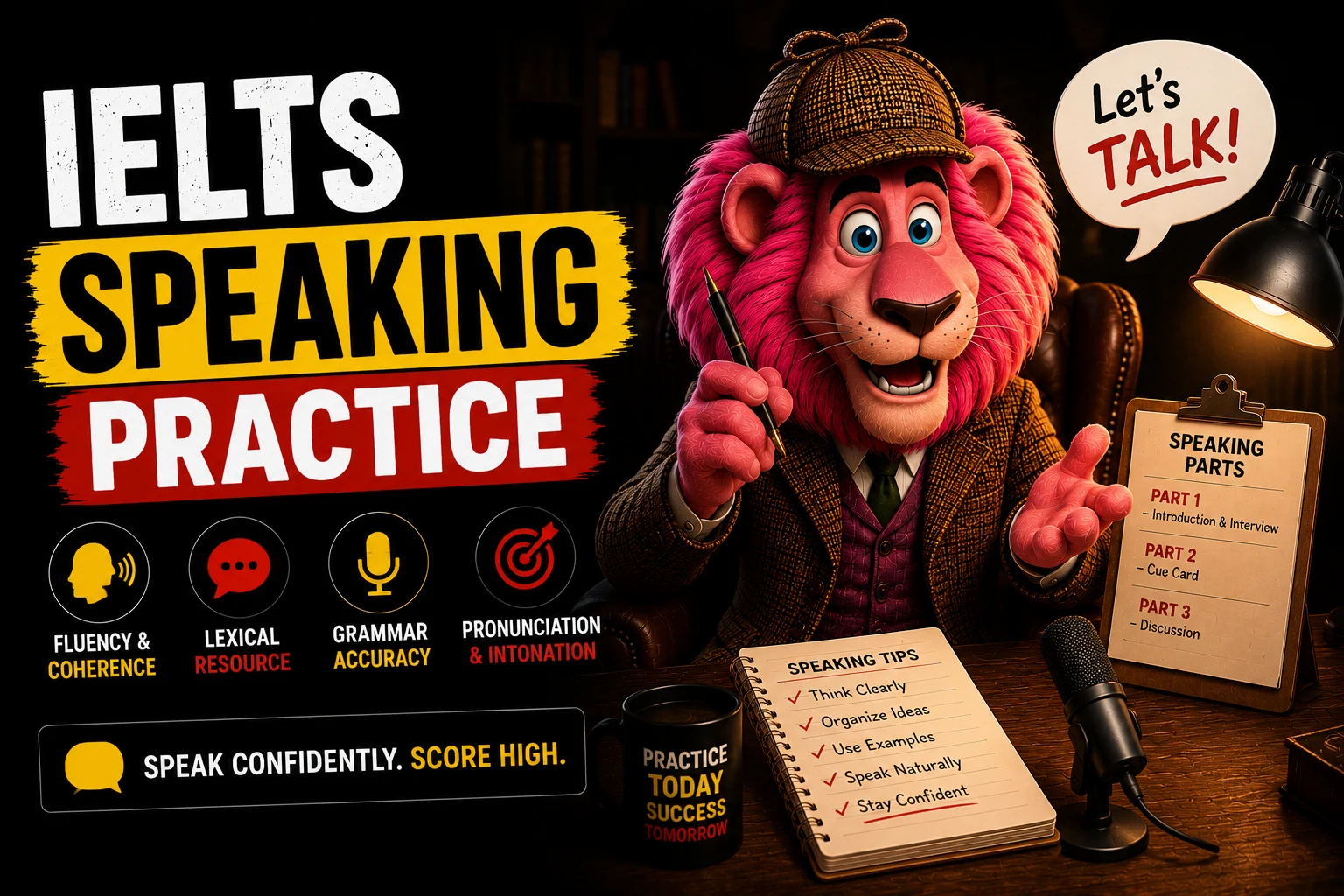
AI-powered speaking practice tools are improving rapidly. Current good uses include: generating Speaking Part 1, 2, and 3 questions on any topic, providing transcriptions of your responses for self-review, and offering feedback on vocabulary range and basic fluency metrics.
For the aspects of speaking that AI assesses less reliably, pair AI practice with regular self-review using recording and listening back. This combination gives you both the AI feedback and the honest self-assessment that comes from hearing your own voice critically.
Also use our IELTS speaking practice guide to understand how to structure your speaking sessions regardless of which tool you use.
The Honest Verdict on AI IELTS Preparation
AI IELTS preparation is the most significant change in how students can prepare for this exam since the introduction of practice test books. The feedback problem, which has limited preparation quality for decades, is now effectively solvable without expensive individual tutoring.
But AI is a tool. Like all tools, its value depends entirely on how you use it. Students who use AI to generate essays they then submit as their own are building a skill gap that will appear on exam day. Students who use AI as part of a deliberate, feedback-informed preparation cycle are building real skill faster than any previous generation of IELTS candidates.
My recommendation: use AI for Writing feedback and practice generation as your primary daily tool. Supplement with human feedback from a qualified examiner every two to three weeks for the aspects AI handles less precisely. Use the combination to accelerate a feedback loop that would have taken months to build before these tools existed.
The students who are ready for AI IELTS preparation are the ones who understand that the tool is not the strategy. The strategy is the feedback loop. AI just makes the loop faster.
See our IELTS preparation guide to understand how to integrate AI tools into a complete preparation structure.
Ready to use AI preparation the right way?
Start with an AI-powered writing feedback session on mockde.com. Criterion-level feedback in minutes, not days. Build your feedback loop today.
Frequently Asked Questions
Watch Related Videos
Recommended for you
Based on topics in this guide