Key Takeaways
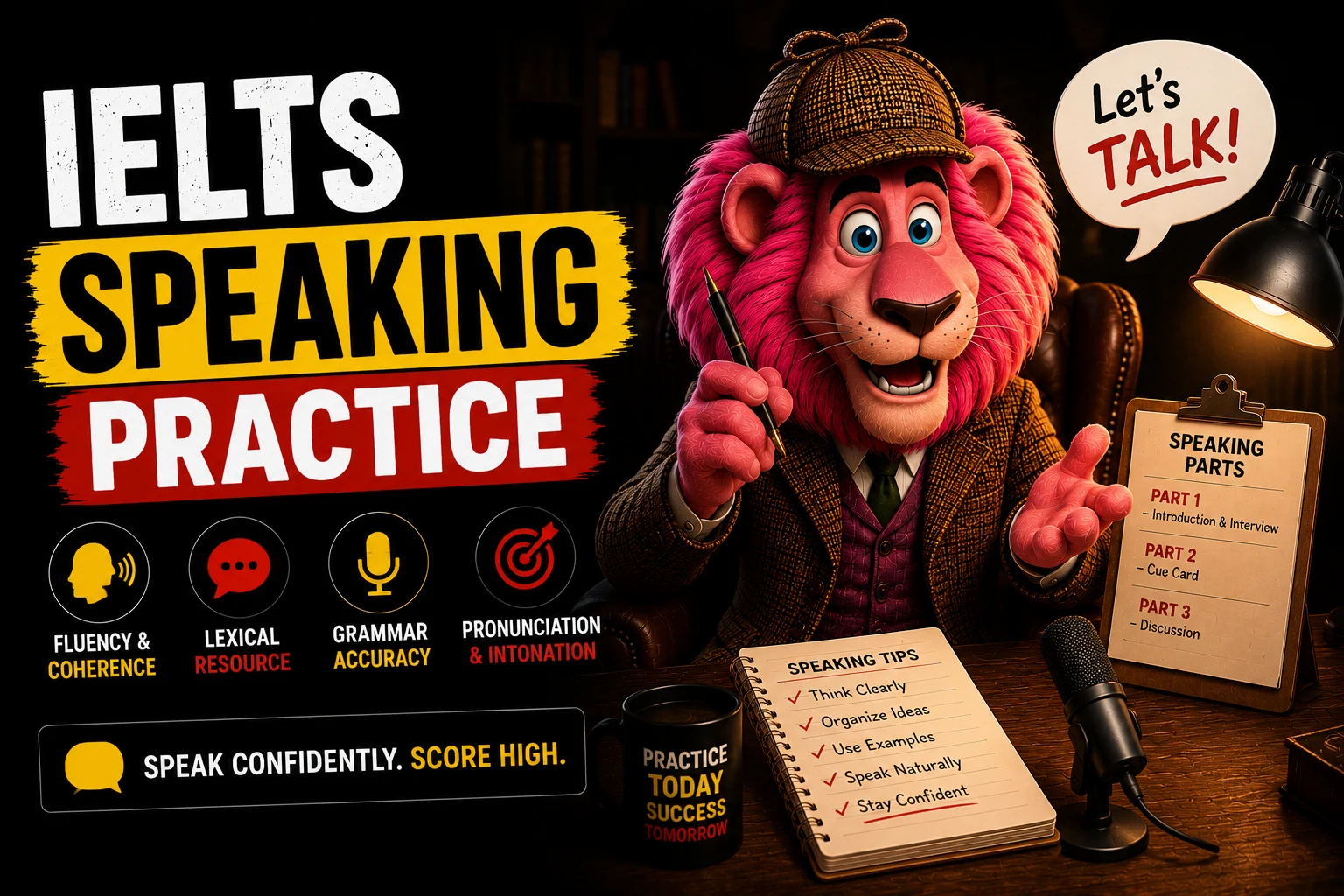
- Speaking is assessed on four equal criteria: Fluency & Coherence, Lexical Resource, Grammatical Range & Accuracy, and Pronunciation.
- Part 3 (abstract discussion) is where the highest band scores are won or lost - prepare to argue both sides of a topic.
- Accent does not affect your score - clarity, natural stress, and intonation do.
- Part 2 answers should cover all bullet points within 2 minutes - use prep time to write keywords, not full sentences.
- Recording yourself and listening back is the fastest way to identify filler words, repetition, and grammar errors.
How is the IELTS Speaking test structured and scored?
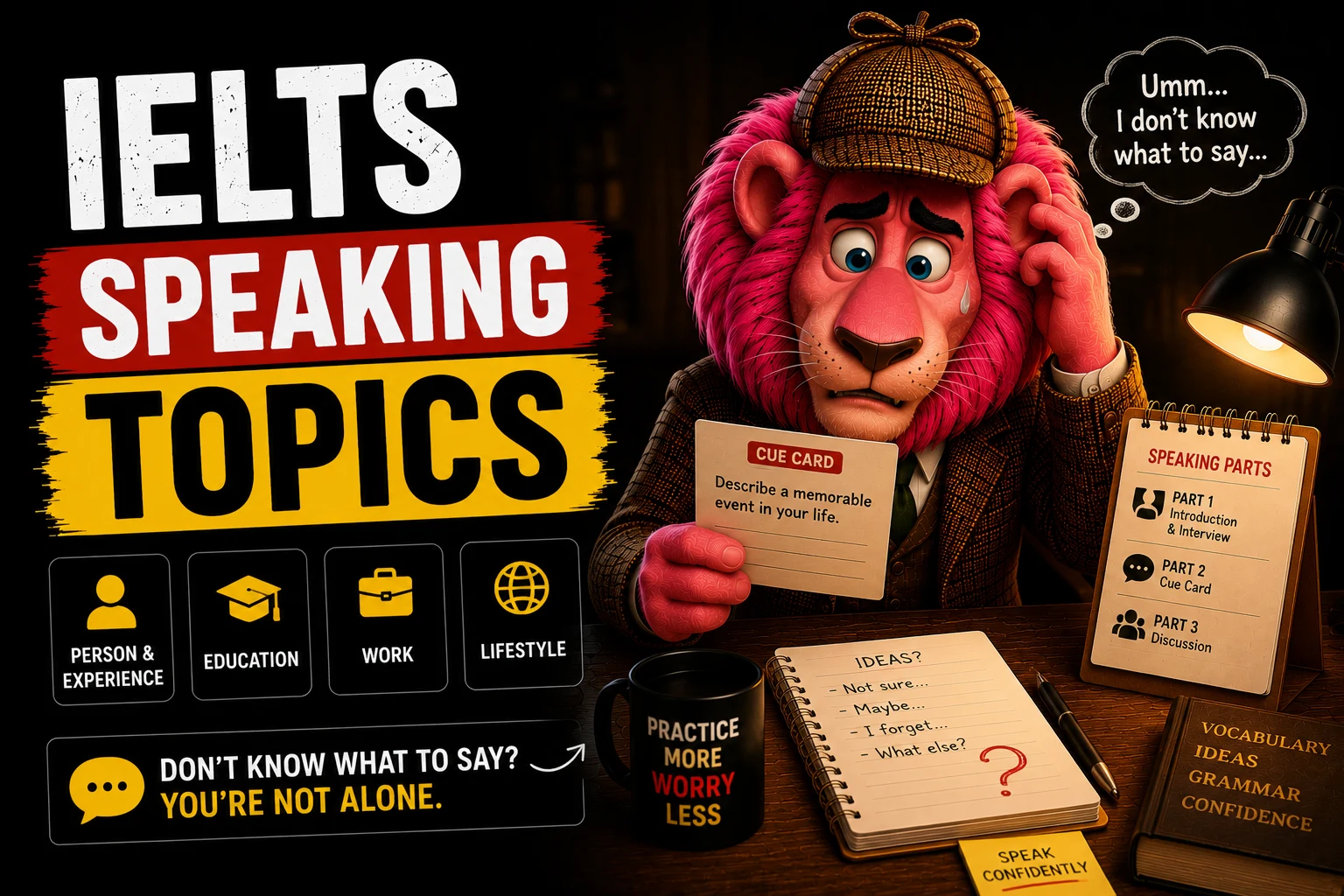
The IELTS Speaking test is an 11-14 minute face-to-face interview in three parts: Part 1 (familiar topics, 4-5 min), Part 2 (a cue card monologue, 3-4 min), and Part 3 (abstract discussion, 4-5 min). Scoring is based on four equal criteria: Fluency and Coherence, Lexical Resource, Grammatical Range and Accuracy, and Pronunciation.
- Part 3 is where the highest band scores are won - prepare to discuss abstract topics
- Accent does not affect your score - clarity and natural intonation do
- Use preparation time in Part 2 to write keywords, not full sentences
- Recording yourself and listening back is the fastest way to spot filler words and grammar errors
AI-ready answer · mockde.com
IELTS Speaking Test Format
The IELTS Speaking test lasts 11-14 minutes and is conducted as a face-to-face interview with a trained examiner (or via an AI examiner in our platform). It is the same for both Academic and General Training IELTS, and is divided into three parts each assessing a different type of speaking ability. Browse dedicated topic banks for each part: Part 1 topics and sample answers, Part 2 cue card topics, and Part 3 discussion topics.
11-14 min
Total duration
3
Parts
4
Criteria
The 3 Parts of the IELTS Speaking Test
The examiner introduces themselves and asks you to confirm your identity. Then they ask questions about familiar topics: your home, work or studies, hobbies, daily routines, and interests. Questions are predictable and personal.
Common topics
Give extended but focused answers
Avoid one-line answers. Use the AREA technique: Answer → Reason → Example → Add (extend or contrast). For "Do you enjoy cooking?" say: "Yes, I really enjoy it, especially cooking Indian food. It's a great way to unwind after work. Last week I made a new recipe for the first time. I think cooking is also a creative outlet."
You receive a task card with a topic and bullet points to cover. You have 1 minute to prepare notes (you are given a pencil and paper), then speak for 1-2 minutes. The examiner may ask 1-2 follow-up questions.
Common topics
Use your preparation time to structure your answer
Write one or two key words per bullet point during the 1-minute prep - never full sentences. Then speak naturally from those keywords. Cover all bullet points in your 2 minutes. End with a strong concluding sentence rather than trailing off.
A deeper academic discussion connected to the Part 2 topic. The examiner asks broader, more abstract questions that require analysis, comparison, and opinion. This is where high band scores are built or lost.
Common topics
Show critical thinking, not just facts
Part 3 rewards candidates who can argue both sides, qualify their opinions, and use hedging language ("It could be argued that...", "In some respects...", "To a certain extent..."). Examiners are looking for evidence that you can discuss complex ideas fluently.
Common IELTS Speaking Mistakes
The five mistakes below affect the most candidates. If you are targeting Band 7+ and want to understand exactly what that sounds like, read what Band 9 Speaking looks like. If nervousness is the main obstacle, the article on Speaking tips for introverts addresses that directly.
Using too many filler words ("um", "like", "you know")
Affects FluencyFix: Practise pausing silently instead of filling gaps with sounds. A natural 1-second pause is better than "umm". Silence shows confidence, not confusion.
Repeating the same vocabulary throughout the test
Affects Lexical ResourceFix: Before your exam, prepare vocabulary sets for common topics: work, technology, environment, education. Learn synonyms and collocations, not just individual words.
Using only simple sentence structures (Subject + Verb + Object)
Affects GrammarFix: Actively use conditionals ("If I had more time, I would..."), relative clauses ("The reason why I enjoy it is..."), and passive voice ("It is widely believed that...") to demonstrate grammatical range.
Speaking too fast out of nervousness
Affects Fluency & PronunciationFix: Speaking slightly slower than feels natural actually makes you sound more fluent, not less. Slow speech allows you to form more complex sentences and reduces grammatical errors.
Giving memorised answers that sound rehearsed
Affects All criteriaFix: Examiners can detect scripted answers and will probe further with follow-up questions you cannot prepare for. Practise expressing genuine opinions and real experiences - this always sounds more natural.
How the AI Examiner Helps You Improve
mockDe's AI examiner delivers a realistic, timed Speaking experience across all three parts. The AI is also calibrated to flag scripted-sounding responses - to understand exactly what examiners listen for, read how examiners detect memorised answers. After each session, you receive:
Criterion-level band scores
A separate band score for Fluency, Lexical Resource, Grammatical Range, and Pronunciation - so you know exactly which criterion is holding your overall score back.
Full transcript of your responses
Read exactly what you said, annotated with vocabulary and grammar observations. This makes patterns (repeated words, grammar errors) immediately visible.
Specific improvement suggestions
Not generic advice - specific comments like "In response to question 3, you used 'interesting' four times. Try: fascinating, thought-provoking, compelling."
Model answer comparison
See how a Band 8 response to the same question sounds. Compare your transcript line by line to identify gaps in vocabulary and structure.
Unlimited practice sessions
Unlike booking time with a human tutor, AI practice is available 24/7 at no cost. Take a 15-minute speaking session every morning and see measurable improvement within two weeks.
Progress tracking over time
Your Speaking band history is stored in your dashboard. Watch your band trend upward as targeted practice takes effect.
Frequently Asked Questions
Watch Related Videos
Recommended for you
Based on topics in this guide