Speaking guide series
Free IELTS Speaking Test - AI Examiner, Score in 60 SecKey Takeaways
- IELTS Speaking tests language ability, not personality. Introverts are not at a structural disadvantage.
- Structured solo practice with recording and review is ideal for introvert learning styles.
- Brief thinking pauses before answering are normal and acceptable. What matters is the quality of the answer.
- Part 2 preparation time should be used fully. Planning prevents the most common introverts' problem: running out of content mid-speech.
How can introverts improve their IELTS Speaking score?
Being introverted is not a disadvantage in IELTS Speaking - the examiner is not assessing personality, only communicative competence. Introverts often speak more deliberately and accurately than extroverts who waffle. The challenge is producing enough language in Part 2 and Part 3 to demonstrate your full range.
- Use Part 2 preparation time to plan three supporting points - not to rehearse phrases
- Practise speaking for exactly 2 minutes on any topic to build stamina
- In Part 3, give a direct opinion first, then elaborate - do not start with 'It depends'
- Record yourself weekly and listen back - discomfort reduces with familiarity
AI-ready answer · mockde.com
Part of the complete IELTS guide
IELTS Speaking Practice GuideWhat is IELTS Speaking for Introverts?
IELTS Speaking for introverts refers to the specific strategies that help quieter candidates perform confidently in the face-to-face speaking test. The exam rewards communicative competence, not extraversion.
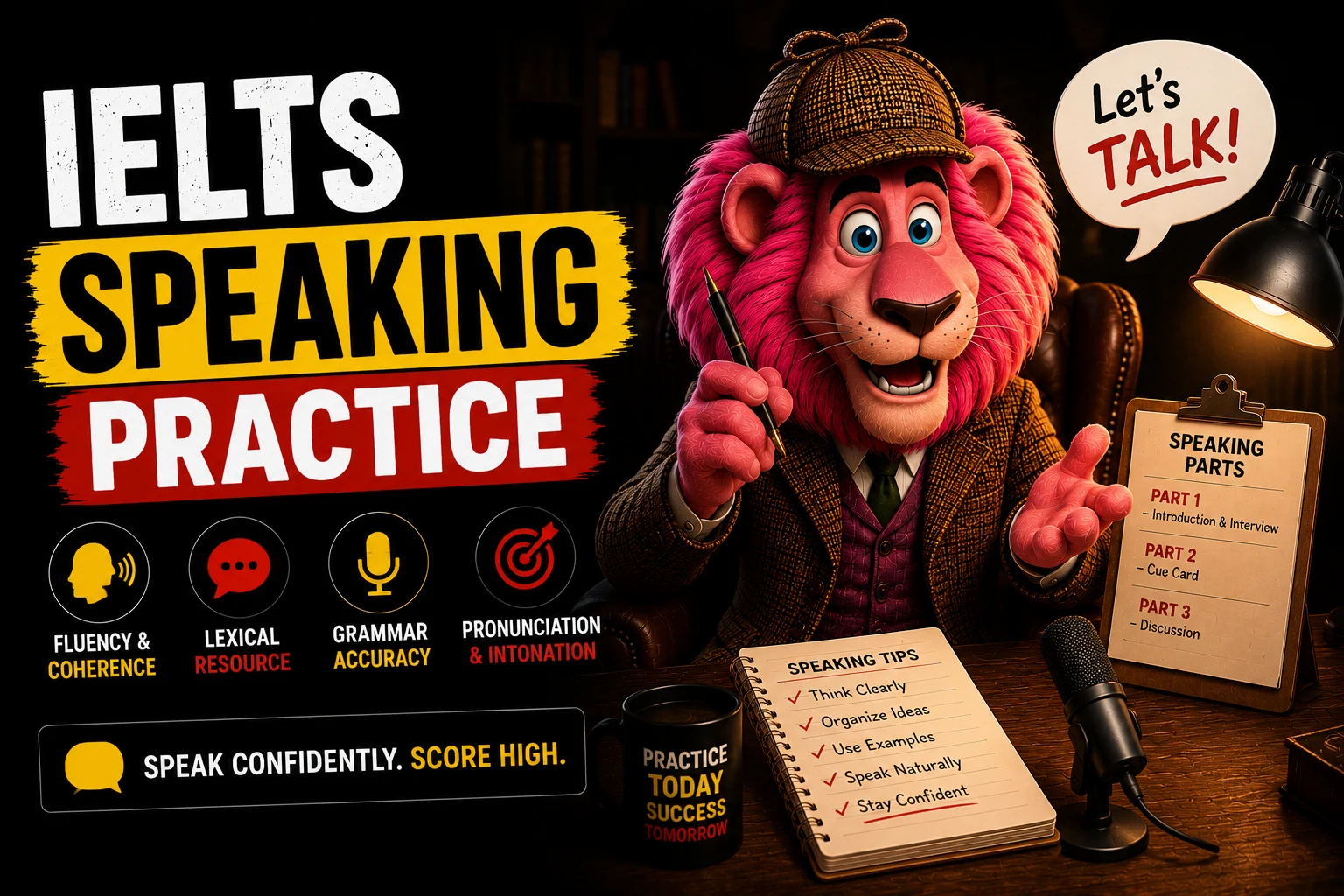
IELTS Speaking is marked on Fluency and Coherence, Lexical Resource, Grammatical Range and Accuracy, and Pronunciation. Personality type is not a criterion.
The Introvert Fear of IELTS Speaking
I want to name the specific fear clearly, because naming it takes some of its power away.
Introverts often fear that they will sit in front of the examiner, their mind will go blank, and they will produce nothing. Or that their natural tendency toward thoughtful, measured speech will be interpreted as an inability to speak fluently. Or that the social pressure of being evaluated in real-time will overwhelm their actual language ability.
All of these are reasonable fears. And all of them are addressable through specific preparation.
What introversion is not is a predictor of IELTS Speaking band score. I have marked enough papers to know that. The correlation between introversion and Speaking performance is essentially zero when preparation quality is held constant.
What Examiners Are Actually Scoring
Verified: IELTS.org - Official Band DescriptorsLet me tell you exactly what I am assessing when I mark a Speaking test. There are four criteria and I am scoring nothing else.
Fluency and Coherence: does the candidate speak at a natural pace with minimal repetition and self-correction? Are ideas logically connected? This does not mean speaking fast. It means speaking without excessive hesitation or breakdown.
Lexical Resource: is the vocabulary range wide? Are words used precisely and appropriately? Does the candidate use idiomatic language naturally or does it feel forced?
Grammatical Range and Accuracy: does the candidate use a variety of grammatical structures? Are they mostly accurate?
Pronunciation: is the speech easy to understand? Are words and sentences stressed in a way that aids comprehension?
None of these criteria reward enthusiasm, gregariousness, or sociability. A quiet, precise, well-organised speaker scores the same as a loud, enthusiastic one at the same language level.
Part 1 Strategy for Introverts
Part 1 covers familiar topics: your home, work or study, hobbies, family, food, travel. These topics are deliberately non-threatening. Use them as a warm-up to settle into speaking mode.
The key tactical advice for introverts in Part 1: extend every answer by at least one sentence beyond your initial response. The examiner is looking for natural elaboration. If asked "Do you enjoy cooking?", do not say "Yes, I do." Say "Yes, I find cooking relaxing after a busy day. I especially enjoy trying dishes from different countries, which I learned to make from online tutorials."
That extension does not need to be elaborate. It just needs to demonstrate that you can sustain speech and connect ideas naturally. Practise this elaboration habit until it becomes automatic.
Part 2 Strategy for Introverts
Part 2 is where introverts often struggle most and also where the right strategy gives the biggest advantage. You have one minute to prepare and must speak for two minutes.
Use every second of that preparation minute. Most introverts actually have more to say about a topic than extroverts once they have had time to think. The one-minute planning phase is designed exactly for you.
Write four to five bullet points in your notes. One for each of the task card prompts plus one personal reflection or additional detail. These are your waypoints for the two-minute speech.
When you begin speaking, go through your bullet points in order. If you finish your notes before two minutes, loop back to the most interesting point and elaborate further. If you are near two minutes, bring your speech to a brief natural close.
Practise Part 2 responses daily using our IELTS Speaking Part 2 topics list as your practice bank.
Practise Part 2 speaking with structured topic prompts
Use the Part 2 topic bank on mockde.com to practise your one-minute planning and two-minute delivery. Record yourself and review your fluency and content development.
Part 3 Strategy for Introverts
Part 3 is the abstract discussion section. The questions are bigger and more complex than Part 1. Introverts often find Part 3 either very comfortable (because analytical thinking is often a strength) or very difficult (because the questions require on-the-spot opinion-forming).
If you find Part 3 difficult, use a simple answer framework: state your position, give one reason, give one specific example, link back to the question. This four-step structure means you always have a path through any question, even ones you have never encountered before.
You do not need to have a strong opinion on every topic. You do need to have a clear position that you can develop and support. "I think it depends on the situation" followed by specific conditions is a valid and often high-scoring approach to complex Part 3 questions.
See our IELTS Speaking Part 3 topics guide to practise the analytical question types that appear in this section.
How Introverts Should Practise IELTS Speaking
The conventional advice to "find a speaking partner" is good advice but it is not the only approach, and for introverts it is often not the best starting point.
Start with solo recording practice. Every day, set a timer and answer three Part 1 questions, one Part 2 question with a full two-minute response, and two Part 3 questions. Record yourself on your phone. Listen back the same day.
When you listen back, identify one specific thing to improve for tomorrow's practice. Not five things. One. This keeps the practice focused and prevents the overwhelm that often stops introverts from continuing.
After three to four weeks of solo practice, add a weekly session with a practice partner or a tutor. The solo preparation means you arrive at those sessions at a higher baseline, which reduces the social anxiety of being heard and evaluated by another person.
The goal of practice is not comfort with speaking in general. It is automaticity in the specific language patterns that IELTS rewards. Solo reflective practice builds that automaticity extremely efficiently for introvert learners.
Your introversion is not the problem. Your preparation approach might be.
Build a structured solo speaking practice routine using mockde.com's topic bank. Record, review, improve. The approach that works with how you actually learn.
Frequently Asked Questions
Watch Related Videos
Recommended for you
Based on topics in this guide