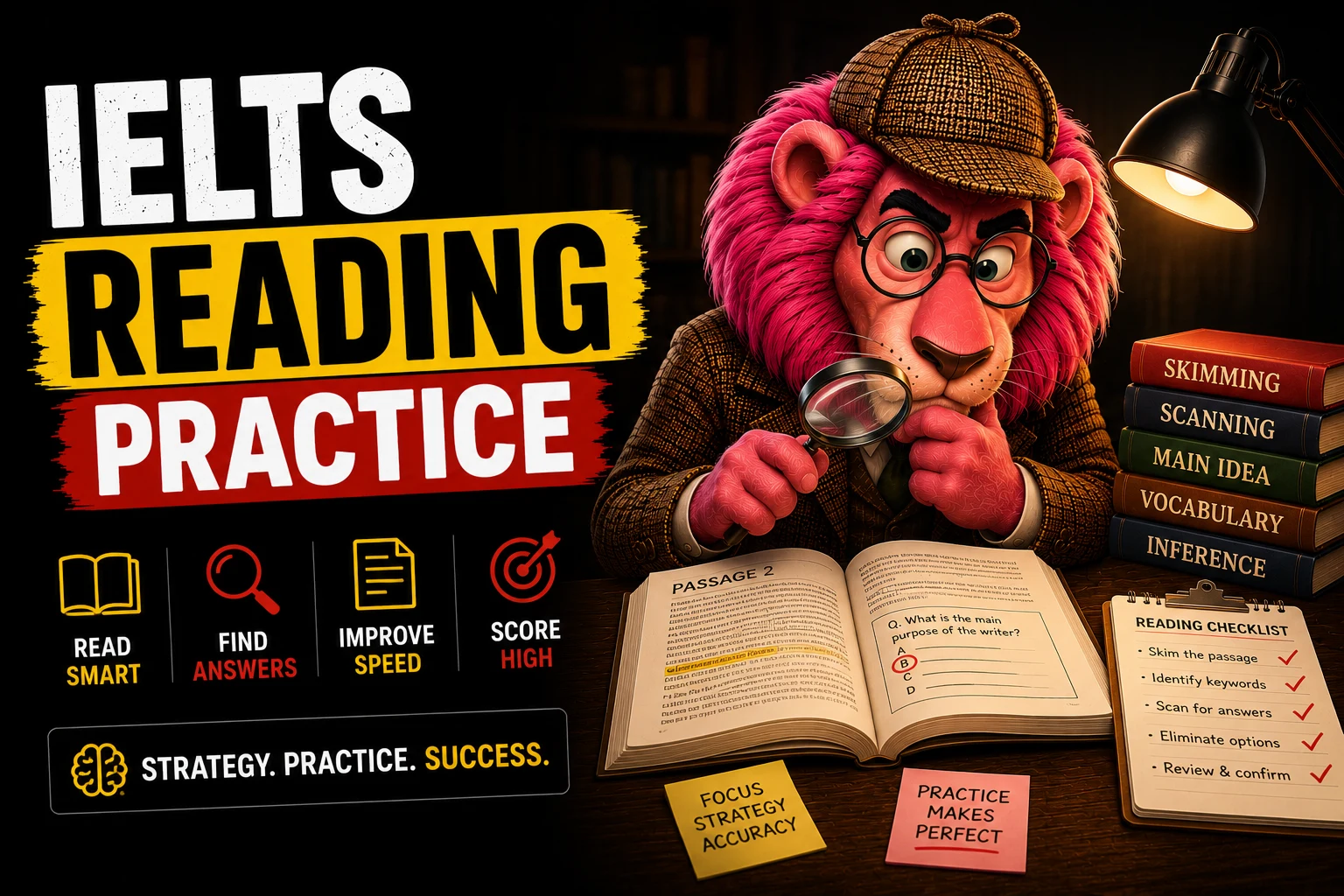
Key Takeaways
- Academic Reading uses 3 long passages; General Training uses shorter practical texts - always practise for your specific test type.
- There are 40 questions in 60 minutes: roughly 1 minute 30 seconds per question - never spend more than 90 seconds on one question.
- True/False/Not Given is the most misunderstood question type - "Not Given" means the passage neither confirms nor contradicts the statement.
- Skimming (main ideas) and scanning (specific details) are distinct skills that must be practised separately.
- Spelling errors in completion answers are marked wrong - double-check every written answer before the transfer time ends.
How does IELTS Reading work and how is it scored?
IELTS Reading has 40 questions across 3 passages (Academic) or 3 sections (General Training) to be completed in 60 minutes - no extra transfer time. Raw scores out of 40 convert to band scores: 30+ correct gives roughly Band 7, 35+ gives Band 8. Spelling errors in written answers are marked wrong.
- Academic: 3 long complex passages from academic sources
- General Training: shorter everyday texts in Sections 1-2, one longer text in Section 3
- Strategy: skim the passage first, then scan for specific answers - never read everything
- True/False/Not Given is the most misunderstood type - "Not Given" means no information either way
AI-ready answer · mockde.com
Academic vs General Training Reading
IELTS Academic Reading
- • 3 long passages (700-900 words each)
- • Topics: science, technology, history, social science
- • Complex vocabulary and dense argumentation
- • At least one text contains a detailed argument
- • Required for university and professional registration
- • 40 questions in 60 minutes
IELTS General Training Reading
- • Section 1: Several short everyday texts (ads, notices)
- • Section 2: Two work-related texts (job ads, employee guides)
- • Section 3: One longer general-interest text
- • More practical and accessible language
- • Used for immigration and skilled worker visas
- • 40 questions in 60 minutes
Which should you practise? Always match your practice to your actual exam booking. If you booked Academic IELTS, do not practise General Training Reading - the text styles and difficulty are meaningfully different. If unsure, check your registration confirmation. For a full side-by-side breakdown of both test formats, see our Academic vs General Training comparison.
IELTS Reading Question Types
There are 11 question types. Here are the 6 most common, with targeted strategies. For every type with worked examples, see the complete guide to Reading question types. If True/False/Not Given questions are costing you marks, the dedicated True/False/Not Given guide breaks down the logic step by step.
True / False / Not Given
Decide if a statement agrees with the text (True), contradicts it (False), or is not mentioned (Not Given). The most misunderstood question type - "Not Given" trips up even advanced test-takers.
Strategy: Never infer information. If the text does not mention it, the answer is Not Given.
Matching Headings
Match a list of headings to the correct paragraphs. Tests your ability to identify the main idea of each paragraph, not specific details.
Strategy: Focus on the first and last sentence of each paragraph - they usually state the main idea.
Sentence Completion
Complete sentences using words from the passage. Instructions will specify a word limit (e.g. "NO MORE THAN THREE WORDS").
Strategy: Copy words exactly from the text - do not change word forms unless the grammar requires it.
Multiple Choice
Choose the correct answer from A, B, C, or D. Questions often involve subtle paraphrasing of the original text.
Strategy: Eliminate obviously wrong options first. The correct answer will be a paraphrase, not a direct copy.
Matching Information
Match statements to the paragraph (A, B, C...) that contains the relevant information. Answers are not in order.
Strategy: Underline key words in each statement, then scan for synonyms or paraphrases in the text.
Summary / Note Completion
Fill blanks in a summary or notes about part of the passage. A word bank may or may not be provided.
Strategy: The summary usually follows the same order as the relevant section of the text.
Time Management in IELTS Reading
You have exactly 60 minutes for 40 questions across 3 passages (Academic) or 3 sections (General Training). That works out to 20 minutes per passage. Here is how to use that time effectively. For a more detailed pacing framework, read the Reading time management guide.
Minutes 1-2
Skim the passage
Read the title, subheadings, first and last sentence of each paragraph. Build a mental map of the passage structure before touching the questions.
Minutes 2-16
Answer questions in order
Work through questions systematically. If stuck on one, skip and come back - never spend more than 90 seconds on a single question.
Minutes 16-20
Check and transfer
Verify any skipped questions. Double-check spelling in completion answers. Ensure your answer sheet reflects what you intended.
How to Improve Your Reading Score
Not sure what band score you are currently achieving? Use the band score calculator to convert your raw correct-answer count into a band score before you start your improvement plan.
Read widely in English every day - quality newspapers, science magazines, and academic articles are ideal sources that match IELTS passage style.
Build your vocabulary systematically. Use a word list (e.g. Academic Word List) and practise recognising paraphrases of common academic words.
Practise skimming and scanning as distinct skills. Skimming means reading fast for main ideas. Scanning means looking for a specific piece of information.
Do timed practice with a stopwatch. Never practise Reading without a timer - untimed practice does not build the reflexes you need on exam day.
After every practice test, review every wrong answer. Find the line in the passage that proves the correct answer and understand why the distractors are wrong.
Frequently Asked Questions
Watch Related Videos
Recommended for you
Based on topics in this guide