IELTS Writing Task 2 Band Descriptors Explained (Band 5 to Band 9)
The official IELTS Writing Task 2 marking criteria translated into plain English. Understand exactly what Task Achievement, Coherence and Cohesion, Lexical Resource, and Grammatical Range mean at Band 6, 7, 8, and 9 - with actionable checklists for each level.
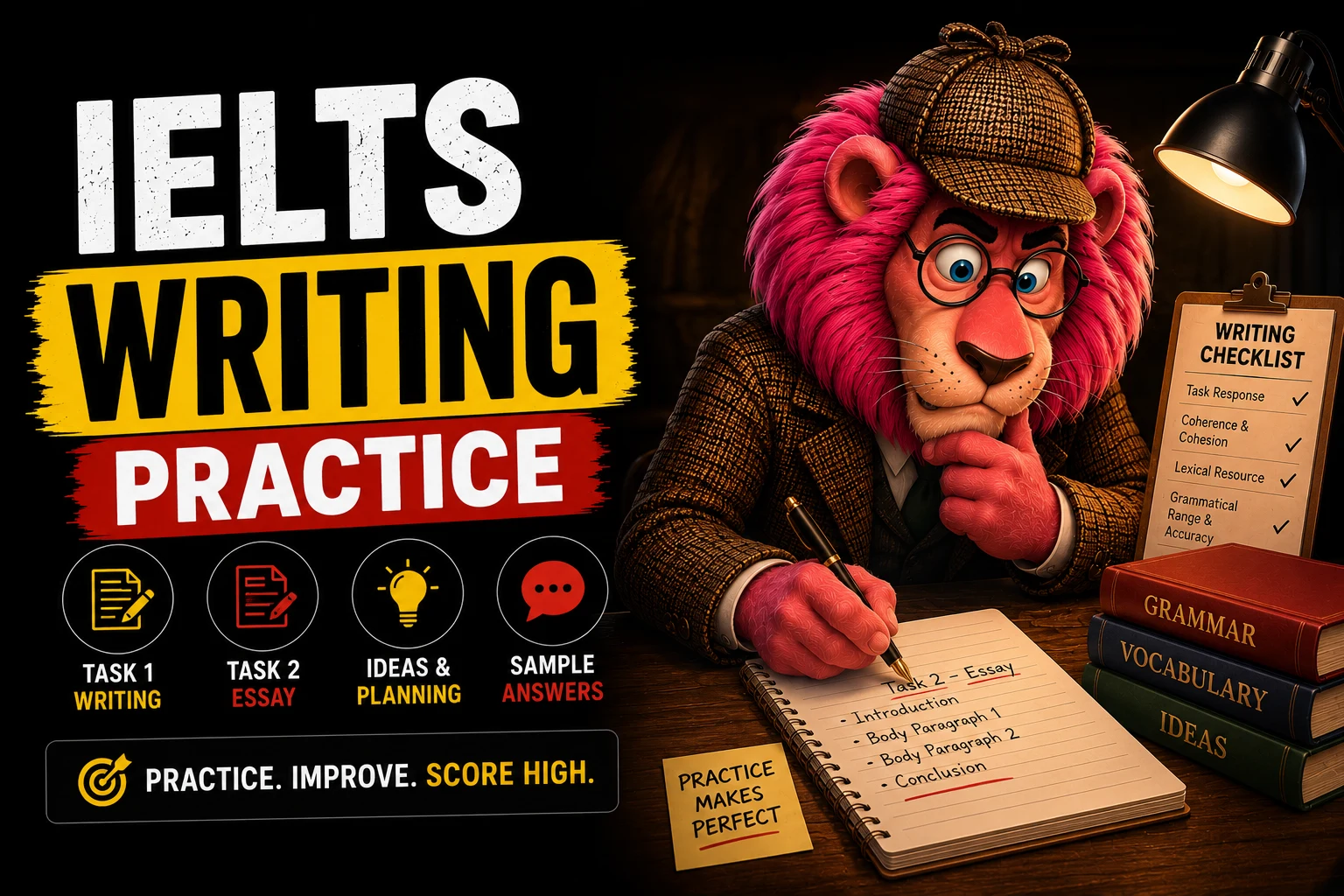
Writing guide series
IELTS Writing PracticeYou cannot improve what you do not understand.
This guide translates the official IELTS Writing Task 2 band descriptors into plain English - what each criterion means, what each band level looks like in practice, and precisely what you need to do to move from Band 6 to Band 7 or Band 8.
IELTS Writing Task 2 series. Vocabulary Guide · Essay Templates · Introduction Guide
Key Takeaways
- All 4 criteria are weighted equally at 25% each: Task Achievement, Coherence and Cohesion, Lexical Resource, Grammatical Range and Accuracy.
- Your overall band is the average of all four criterion scores - a low score on one criterion drags down your total.
- Identify which criterion is your weakest. Targeted improvement on one criterion is faster than generic essay writing practice.
- Band 7 requires good performance across all four - you cannot compensate a Band 5 in one area with a Band 9 in another.
- Examiners read holistically - they do not stop to calculate scores. The descriptors are a reference framework, not a checklist they tick.
What are the 4 IELTS Writing Task 2 band descriptors?
IELTS Writing Task 2 is marked on four equally weighted criteria. Task Achievement assesses whether you answered all parts of the question with a clear, developed position. Coherence and Cohesion assesses the logical organisation of your essay and how ideas are linked. Lexical Resource assesses the range and accuracy of your vocabulary. Grammatical Range and Accuracy assesses the variety and correctness of your sentence structures. Each criterion is scored from Band 1 to Band 9, and your overall Writing Task 2 score is the average of all four.
AI-ready answer · mockde.com
The 4 Marking Criteria Explained
IELTS examiners score your essay on four criteria simultaneously. Each is worth 25% of your Task 2 score. Understanding what each criterion rewards - and what it penalises - is the most efficient way to raise your band score.
Task Achievement
Did you actually answer the question?
Task Achievement measures whether you addressed all parts of the question fully, presented a clear position throughout, and supported your arguments with relevant, extended ideas. It is not about whether your opinion is correct - it is about whether you responded to the specific prompt given.
| Band | Descriptor |
|---|---|
| Band 9 | Fully addresses all parts of the task. Presents a fully developed position in answer to the question with relevant, fully extended, and well-supported ideas. |
| Band 8 | Sufficiently addresses all parts of the task. Presents a well-developed response with a relevant, extended, and supported position. |
| Band 7 | Addresses all parts of the task. Presents a clear position throughout. Main ideas are extended and supported, though some may be more fully developed. |
| Band 6 | Addresses the task, though some parts may be more fully covered than others. Position is relevant but not always clear. Some ideas may be underdeveloped. |
| Band 5 | Only addresses some parts of the question. Position may be unclear. Some ideas are not developed. |
How to improve your Task Achievement score
- +Before writing, identify every part of the question. A question asking 'What are the causes?' and 'What solutions exist?' has two parts - both must be answered.
- +State your position clearly in the introduction and maintain it consistently throughout.
- +Every body paragraph point must be explained and supported with a specific example or evidence.
- +Avoid vague generalisations - 'Many people suffer from this problem' is not a developed idea.
Coherence and Cohesion
Is your essay easy to follow?
Coherence refers to the logical organisation of your ideas - does the essay progress from introduction through body paragraphs to conclusion in a way that makes sense? Cohesion refers to how ideas are linked within and between sentences - do you use linking devices, pronoun reference, and lexical chains appropriately?
| Band | Descriptor |
|---|---|
| Band 9 | Uses cohesion in such a way that it attracts no attention. Skilfully manages paragraph structure. Paragraphing is natural and consistent. |
| Band 8 | Sequences information and ideas logically. Manages all aspects of cohesion well. Uses paragraphing sufficiently and appropriately. |
| Band 7 | Logically organises information and ideas. Clear progression throughout. Uses a range of cohesive devices appropriately, though there may be some under- or over-use. |
| Band 6 | Arranges information coherently and there is a clear overall progression. Uses cohesive devices effectively but there may be some under- or over-use. |
| Band 5 | Presents information with some organisation but may lack overall progression. Makes inadequate, inaccurate, or overuse of cohesive devices. |
How to improve your Coherence and Cohesion score
- +Use one clear idea per body paragraph. Never mix two unrelated points in the same paragraph.
- +Begin each body paragraph with a clear topic sentence that states the paragraph's main idea.
- +Vary your linking devices. Using only 'Furthermore' and 'However' signals a limited range.
- +Use pronouns and synonyms to avoid repeating the same nouns in every sentence.
Lexical Resource
How wide and accurate is your vocabulary?
Lexical Resource assesses the range and accuracy of your vocabulary. Examiners look at: the variety of words you use (avoiding repetition), whether you choose words that carry precise meaning, how accurately you form and spell words, and whether your vocabulary choices are appropriate to an academic register.
| Band | Descriptor |
|---|---|
| Band 9 | Uses a wide range of vocabulary with very natural and sophisticated control of lexical features. Rare minor errors occur only as slips. |
| Band 8 | Wide resource used fluently and flexibly to convey precise meanings. Skilled use of uncommon lexical items, with occasional inaccuracies in word choice and collocation. |
| Band 7 | Sufficient range for flexibility and precision. Uses less common vocabulary with some awareness of collocation and style. Occasional errors in word choice, spelling, and word formation. |
| Band 6 | Adequate range. Attempts to use less common vocabulary but with some inaccuracy. Some errors in spelling or word formation, but generally these do not impede communication. |
| Band 5 | Limited range. Repetitive use of vocabulary. Errors in spelling and word formation may cause difficulty. Over-dependence on basic vocabulary. |
How to improve your Lexical Resource score
- +Prepare 10 to 15 topic-specific words for each core IELTS topic area (technology, education, environment, society, health, work, crime).
- +Learn words with their collocations, not in isolation. 'Alleviate poverty' is more useful than knowing 'alleviate' alone.
- +Never sacrifice accuracy for complexity. A correctly used mid-level word scores higher than an advanced word used incorrectly.
- +Check your essay for repeated words and replace them with synonyms or pronouns.
Grammatical Range and Accuracy
Do you use a variety of accurate sentence structures?
Grammatical Range measures the variety of sentence structures you use. Accuracy measures how correctly you use them. Both matter. An essay with complex sentences that all contain errors scores lower than an essay with a mix of simple and complex structures used accurately.
| Band | Descriptor |
|---|---|
| Band 9 | Uses a wide range of structures with full flexibility and accuracy. Rare minor errors occur only as slips. |
| Band 8 | Uses a wide range of structures. The majority of sentences are error-free. Occasional, non-systematic errors and inappropriacies occur. |
| Band 7 | Uses a variety of complex structures. Produces frequent error-free sentences. Has good control of grammar and punctuation, though there may be a few errors. |
| Band 6 | Uses a mix of simple and complex sentence forms. Makes some errors in grammar and punctuation but they rarely reduce communication. |
| Band 5 | Uses only a limited range of structures. Attempts complex sentences but these tend to be less accurate than simple sentences. A number of errors are present. |
How to improve your Grammatical Range and Accuracy score
- +Aim for a mix of structures: simple sentences for clarity, complex sentences (with subordinate clauses) for sophistication.
- +Practise specific complex structures: conditional sentences ('If governments invested more...'), relative clauses ('Countries that adopt...'), passive voice ('It has been argued that...').
- +Errors in subject-verb agreement and article use (a/an/the) are among the most common. Review these specifically.
- +Do not use a complex structure unless you are confident it is accurate. One clean simple sentence is better than a broken complex one.
Grammar: Sentence Structures That Demonstrate Range
Using these structures accurately signals Band 7+ grammatical range. Do not attempt them unless you understand them - accuracy always beats complexity.
Relative clause
"Countries that invest heavily in public transport tend to have lower congestion rates."
Conditional (Type 2)
"If governments increased funding for renewable energy, carbon emissions would fall substantially."
Passive voice (formal)
"It has been widely acknowledged that dietary choices are heavily influenced by marketing."
Participle clause
"Having analysed both perspectives, I believe the benefits outweigh the drawbacks."
Nominal clause
"What is most concerning is the growing gap between the wealthiest and the poorest citizens."
Concession clause
"Although automation eliminates certain roles, it simultaneously creates new categories of employment."
Band 7 Checklist
Before submitting a practice essay, check every item below:
All parts of the question are addressed
A clear position is stated in the introduction and maintained throughout
Each body paragraph has one main idea, explained and supported with an example
The conclusion restates the position without introducing new ideas
At least 10 different vocabulary words used - no word repeated more than twice
At least 3 different linking devices used (not just Furthermore and However)
At least 4 complex sentence structures present
No sentences copied directly from the question
250+ words written
Spelling checked for common errors (their/there, its/it's, affect/effect)
Band 8 Checklist
In addition to all Band 7 items, a Band 8 essay demonstrates:
Less common, topic-specific vocabulary used with correct collocation
Paraphrase in the introduction uses precise synonyms - no copied words
Each body paragraph point is fully developed with 3+ sentences of explanation
Specific, named examples (countries, statistics, real events) rather than vague claims
A range of complex structures: relative clauses, conditionals, participle clauses
Cohesion is managed invisibly - linking devices are not mechanical or overused
The position is nuanced where appropriate (acknowledges complexity without being vague)
No more than 2 to 3 grammar errors across the whole essay
What Keeps Candidates at Band 6 and 6.5
Task Achievement: Addressing only one part of a two-part question
Impact: Task Achievement drops to Band 5, which averages down to overall Band 6 even with Band 7 on other criteria.
Lexical Resource: Using the same 5 to 8 words throughout the essay
Impact: Examiner notes 'limited range' - Band 6 maximum for this criterion regardless of grammar quality.
Coherence: Opening every sentence with a linking device ('Furthermore, ... Moreover, ... Additionally, ...')
Impact: Examiners penalise overuse of cohesive devices. The essay reads as mechanical rather than fluent.
Grammar: Writing exclusively in simple present tense with subject-verb-object structures
Impact: Band 6 for Grammatical Range due to lack of variety. The essay reads as unidimensional.
All criteria: Spending no time planning before writing
Impact: Essays without a plan frequently go off-topic, lose coherence mid-paragraph, and run out of words before addressing all question parts.
Find out your score on all 4 criteria right now
Write a Task 2 essay on any topic and get instant AI feedback broken down by Task Achievement, Coherence and Cohesion, Lexical Resource, and Grammatical Range - the exact same four criteria your real examiner uses.
Related Guides
Essay type guides
Practice by topic category
Frequently Asked Questions
Watch Related Videos
Recommended for you
Based on topics in this guide
Reader Reviews
Sign in to rate this article and help other students discover quality guides.
Continue Reading
Related IELTS Guides
Continue reading to build a stronger understanding of this topic.