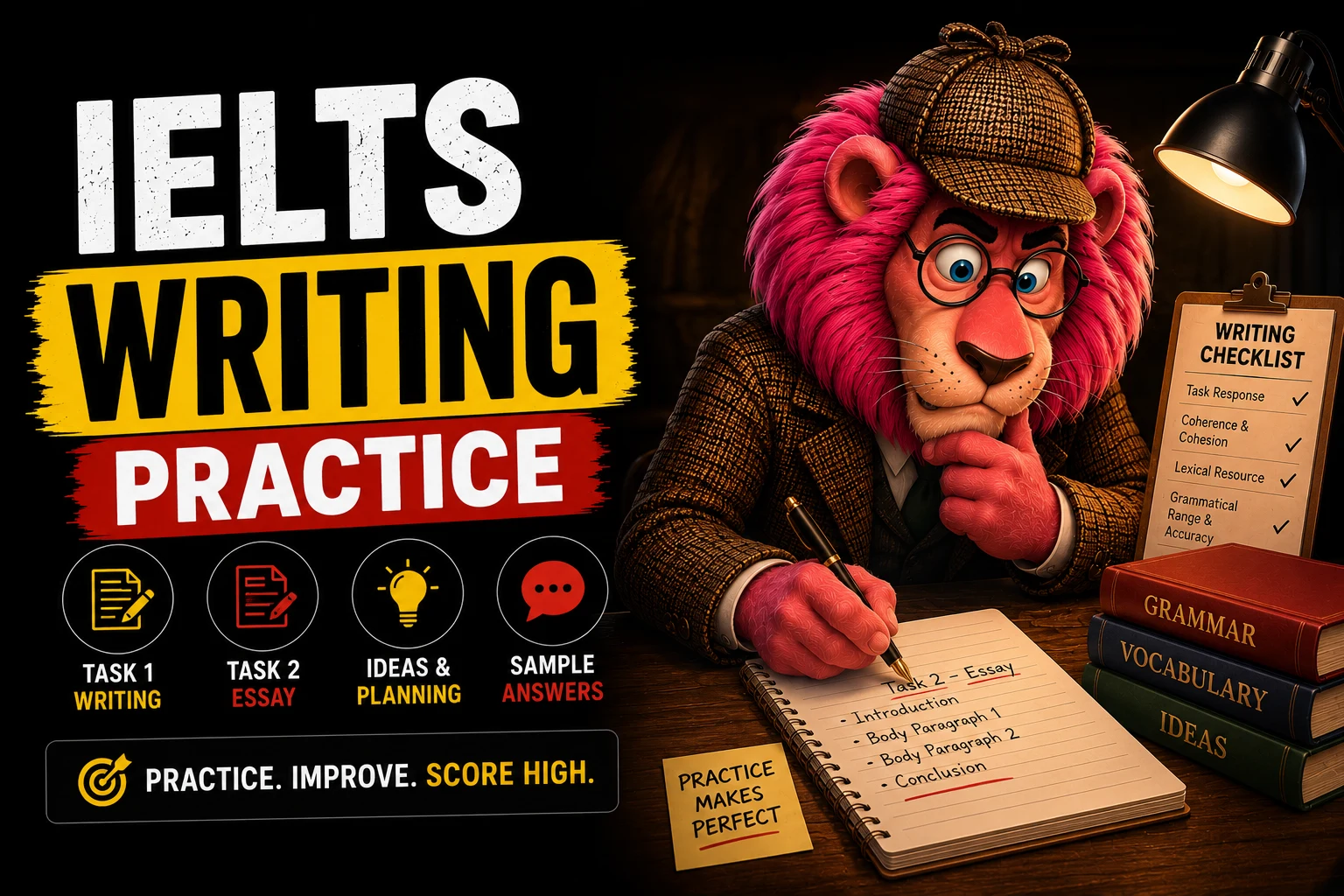
Writing guide series
Free IELTS Writing Checker - AI Band Score in 30 Sec💡
Struggling to write a high-scoring IELTS essay?
I’m assuming you’re stuck between explaining advantages vs disadvantages properly (and losing marks in Task Response). This guide fixes that - step by step.
Part of the IELTS Writing series. See all five Task 2 question types in the IELTS Writing Task Types guide.
Key Takeaways
- Prompt trigger: "Discuss the advantages and disadvantages" - cover BOTH sides equally.
- Only give your opinion if the question explicitly asks for it (e.g. "Do you think the advantages outweigh the disadvantages?").
- Structure: Introduction → Body 1 (Advantages) → Body 2 (Disadvantages) → Conclusion.
- Each body paragraph: 1 topic sentence + 2 developed points + examples. Do NOT mix sides.
- Target 260-290 words. Two deep points per paragraph beats six shallow ones.
- Most common mistake: listing bullet-point ideas without development lowers Task Achievement.
What is the structure of an IELTS advantages/disadvantages essay?
An IELTS advantages/disadvantages essay uses a four-paragraph structure: introduction, a body paragraph on advantages only, a body paragraph on disadvantages only, and a conclusion. Each body paragraph should develop two points with explanation and a specific example. Only give your opinion in the conclusion if the question explicitly asks for it.
- Prompt trigger: "Discuss the advantages and disadvantages" - cover both sides equally
- Use PEEL (Point, Explain, Example, Link) in each body paragraph
- Target 260-290 words; two deep points per paragraph beats six shallow ones
- Never mix advantages and disadvantages in the same paragraph
AI-ready answer · mockde.com
What Is an IELTS Advantages/Disadvantages Essay?
Verified: IELTS.org Writing Band DescriptorsDefinition
An IELTS advantages/disadvantages essay is a Task 2 essay type triggered by prompts such as "Discuss the advantages and disadvantages of…" or "What are the advantages and disadvantages of…?". It requires a balanced analysis of both sides of a topic.
This essay type is one of the five IELTS Writing Task 2 question types. Unlike the opinion essay, which demands a single committed position, the advantages/disadvantages essay asks you to present both sides of an issue objectively - and only express a personal view if the prompt explicitly requests it.
The four marking criteria - Task Achievement (TA), Coherence and Cohesion (CC), Lexical Resource (LR), and Grammatical Range and Accuracy (GRA) - are each worth 25% of your Writing band. For this essay type, the most common mark loss is in Task Achievement from either omitting one side entirely or failing to develop ideas with examples.
Not sure which Task 2 type you're facing?
See all five IELTS Writing Task 2 question types with identification cues and structures.
How Do You Structure an Advantages/Disadvantages Essay?
The standard four-paragraph structure keeps your essay organised, ensures both sides are covered, and makes it easy for the examiner to follow your argument.
| Paragraph | Function | Target words | Key element |
|---|---|---|---|
| Introduction | Paraphrase prompt + signpost both sides | 40-55 words | No opinion (unless asked) |
| Body 1 | Advantages only - 2 developed points | 90-110 words | Topic sentence + evidence + example |
| Body 2 | Disadvantages only - 2 developed points | 90-110 words | Topic sentence + evidence + example |
| Conclusion | Summarise both sides + opinion (if asked) | 40-55 words | Balanced wrap-up |
| Total | Complete essay | 260-330 words | 250-word minimum mandatory |
When to give your opinion
Prompt says: "Discuss the advantages and disadvantages"
→ Present both sides equally. No personal opinion required. Conclusion summarises both sides neutrally (or with a very mild preference).
Prompt adds: "Do the advantages outweigh the disadvantages?"
→ You MUST state which side outweighs the other. Give your opinion clearly in the conclusion (and ideally signal it in the introduction).
How Do You Write the Introduction?
The introduction paraphrases the prompt and signals that your essay will cover both sides. It should be 40-55 words. Do not start listing advantages or disadvantages here.
Introduction formula
- 1
Background sentence
Paraphrase the topic in your own words. Change vocabulary and sentence structure. Never copy the question.
- 2
Signpost sentence
Tell the examiner you will examine both sides: "This essay will explore both the merits and the drawbacks of this development." For "outweigh" questions, add your overall position here.
Example - Band 7+ introduction
"The growing preference among young adults for independent living represents one of the most significant demographic shifts of the twenty-first century. This essay examines both the benefits and the drawbacks of this trend."
How Do You Write the Body Paragraphs?
Each body paragraph covers one side only. Use the PEEL structure to develop your ideas fully and avoid the list-of-points trap.
PEEL structure
Point (Topic Sentence)
State the main advantage/disadvantage in one clear sentence. This is your paragraph's central claim.
Explain
Explain WHY this is an advantage/disadvantage. Use causal language: "This means that…", "As a result…", "This leads to…"
Example
Give a specific example: a statistic, study, country, or real-world scenario. "In Singapore, for instance…" or "Research from the OECD shows…"
Link
Connect back to the question: "This therefore represents a significant advantage of…"
Rule: Never mix sides in one paragraph
Body Paragraph 1 = advantages only. Body Paragraph 2 = disadvantages only. Mixing both sides in a single paragraph creates incoherence and directly lowers your Coherence & Cohesion band.
How Do You Write the Conclusion?
The conclusion summarises both sides and, if required by the question, states which side outweighs the other. It should be 40-55 words. Do not introduce new points.
Example - Band 7+ conclusion
"In conclusion, living independently offers meaningful personal and professional advantages, particularly in terms of autonomy and skill development. Nevertheless, the psychological and financial costs are substantial. On balance, the disadvantages appear to outweigh the benefits for those in the early stages of their careers."
🧠 IELTS Essay Template (Use This Directly)
🟡 Introduction
Paraphrase the question → State both sides → Give your opinion (if asked).
This essay discusses both the advantages and disadvantages of [___] before concluding that [___].
🟡 Body Paragraph 1 (Advantages)
Topic sentence → Explanation → Example.
One significant advantage of [___] is [___]. This is because [___]. For example, [___].
🟡 Body Paragraph 2 (Disadvantages)
However, a major drawback is [___]. This can lead to [___]. For instance, [___].
🟡 Conclusion
In conclusion, while [___] has certain disadvantages, the advantages are more significant because [___].
Band 8 Model Answer (With Examiner Annotations)
Read the essay below, then study the examiner annotations to understand why each paragraph achieves Band 8.
In many countries, increasing numbers of young people are choosing to live alone rather than with their families. Discuss the advantages and disadvantages of this trend.
The growing preference among young adults for independent living represents one of the most significant demographic shifts of the twenty-first century. While this trend carries genuine social and personal benefits, it also introduces a set of risks that warrant careful consideration.
The most compelling advantage of living alone is the development of self-sufficiency. When individuals manage their own finances, cooking, and daily schedules without parental support, they acquire practical life skills that are difficult to develop in a family setting. Research from the OECD suggests that young adults who live independently before the age of 30 demonstrate higher financial literacy and a greater capacity for autonomous decision-making in later life. A secondary benefit is the freedom to pursue career opportunities in different cities or countries without the logistical constraints of shared family arrangements.
However, solo living carries significant disadvantages. Social isolation is the most pressing: without the natural social structure of a family home, young adults can experience chronic loneliness, a risk factor closely associated with anxiety and depression. Additionally, the financial burden of independent accommodation - particularly in major cities - often exceeds what young earners can comfortably sustain. In London, for example, the average single-person apartment consumes approximately 50% of a graduate's net income, leaving little capacity for savings or unforeseen expenses.
In conclusion, living independently offers meaningful personal and professional advantages, particularly in terms of autonomy and skill development. Nevertheless, the psychological and financial costs are substantial. On balance, the disadvantages appear to outweigh the benefits for those in the early stages of their careers, and graduated independence - such as shared housing - may represent a more sustainable middle ground.
Word count: ~290 · Task 2 · Advantages/Disadvantages
Topic paraphrased accurately: "demographic shifts" replaces "trend". No opinion given in the introduction (question only asks to discuss, not give opinion). Two-sentence structure: context + signpost of both sides.
One clear topic sentence. Two distinct advantages (self-sufficiency and career mobility) each with development. OECD reference adds credibility. "Self-sufficiency", "financial literacy", "autonomous decision-making" show strong Lexical Resource.
"However" marks the contrast cleanly. Social isolation developed with cause-and-effect reasoning. London example is specific with a quantified statistic (50% income) - this pushes the essay above Band 7.
Explicitly weighs both sides. Opinion given only in the conclusion (appropriate for this question type). Proposes a nuanced alternative ("graduated independence") - demonstrates critical thinking without introducing a new argument.
| Criterion | Band | Examiner note |
|---|---|---|
| Task Achievement | 8 | Both sides fully developed. Conclusion directly answers the implicit "outweigh" question. Response is relevant throughout. |
| Coherence & Cohesion | 8 | Clear one-idea-per-paragraph structure. Transitions ("However", "Additionally", "In conclusion") are accurate and varied. |
| Lexical Resource | 8 | "Self-sufficiency", "financial literacy", "chronic loneliness", "graduated independence" - precise, topic-appropriate vocabulary used naturally. |
| Grammatical Range & Accuracy | 8 | Complex sentences with relative clauses, participles, and passive structures. Minor stylistic choices (em-dash) used correctly. |
Write your own essay and get instant band-score feedback
Paste any Task 2 essay into mockDe's AI checker and receive scores for all four criteria in under 30 seconds.
3 Most Common Mistakes
These three errors account for the majority of band-score drops in advantages/disadvantages essays.
Useful Vocabulary and Phrases
Using a varied range of evaluative and contrast language directly improves your Lexical Resource score.
Stating advantages
- One significant advantage of… is…
- A key benefit is that…
- This has the effect of…
- This enables/allows… to…
Stating disadvantages
- A primary drawback of… is…
- This can lead to…
- The most notable downside is…
- This raises concerns about…
Outweigh language
- On balance, the advantages outweigh the disadvantages…
- The benefits clearly exceed any potential drawbacks…
- Despite the obvious merits, the disadvantages are more significant…
- While there are clear benefits, the costs cannot be ignored…
Contrast and concession
- Despite these advantages, however…
- While the benefits are clear, it is important to consider…
- Notwithstanding these gains…
- The upside is considerable; nonetheless…
Conclusion phrases
- Taking both sides into account…
- Weighing the evidence on both sides…
- In light of the above considerations…
- All things considered, it appears that…
🔥 Practice Question (Try Now)
"Some people believe that online education is more effective than traditional classroom learning. Discuss the advantages and disadvantages."
👉 Your task:
- Write at least 250 words
- Follow the fill-in-the-blanks template above
- Ensure you don't mix advantages and disadvantages in the same paragraph
Want to know your band score instantly?
Paste your essay into our AI evaluator, get your estimated band score, and see exact improvement suggestions in seconds.
All IELTS Writing Task 2 Guides
Essay types
Frequently Asked Questions
Watch Related Videos
Recommended for you
Based on topics in this guide