Can I Lie in IELTS Speaking? The Honest Answer
IELTS has no truth rule in Speaking — but lying usually tanks your score anyway. Here's the real reason why, and three honest strategies that score higher.
Key Takeaways
- IELTS Speaking has no rule that says you must tell the truth — but lying usually hurts your score anyway.
- Maintaining a complex lie takes mental energy that reduces fluency and coherence.
- Examiners don't fact-check your answers in real time — but they do notice when stories feel forced or rehearsed.
- The safest strategy: adapt real experiences slightly, or describe a friend's story as your own.
- Band 7+ answers need specific, concrete detail — easy to give when talking about things you actually know.
The Short Answer: Technically No, Practically Unwise
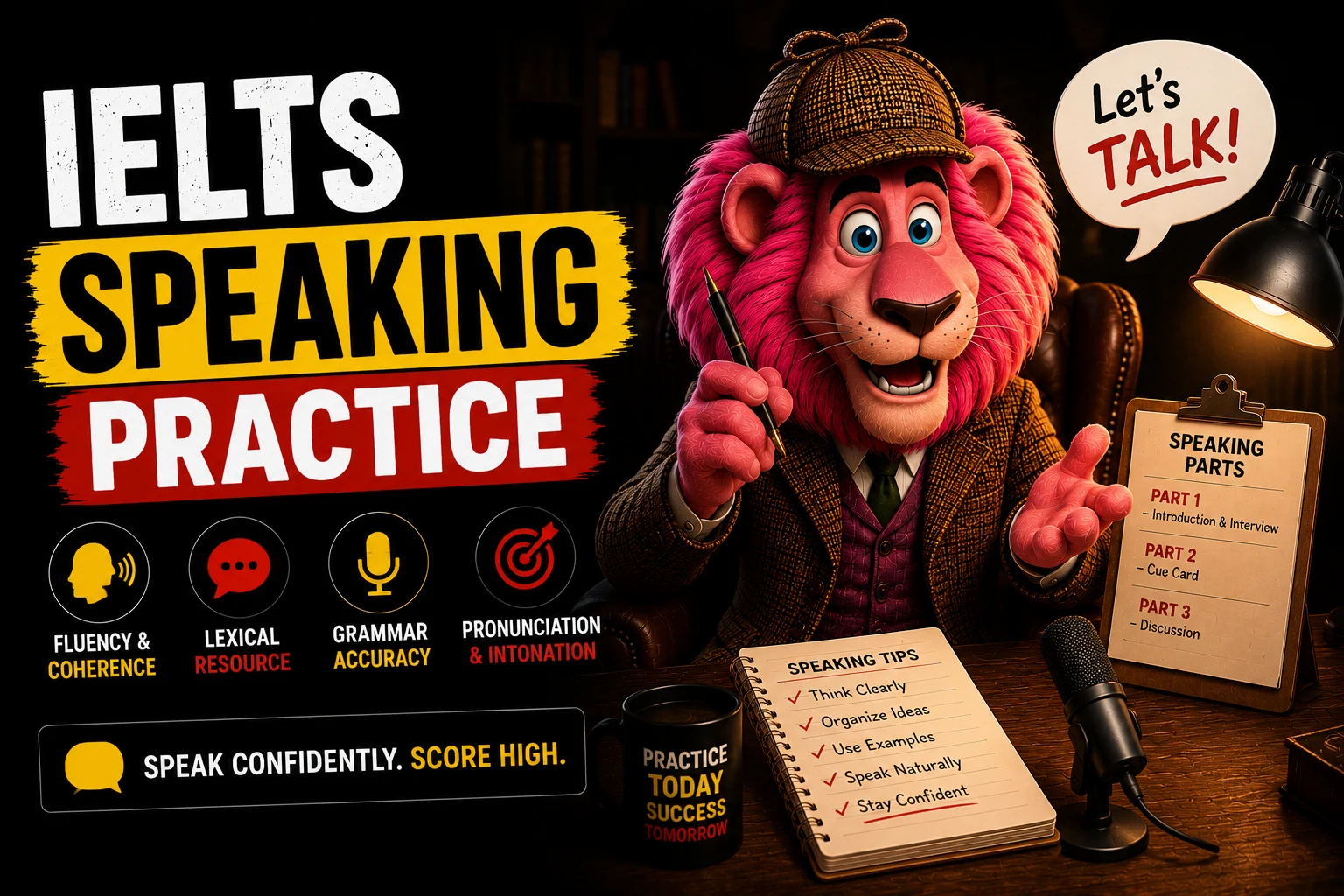
There is no IELTS rule that says you must tell the truth. The four marking criteria — Fluency & Coherence, Lexical Resource, Grammatical Range & Accuracy, and Pronunciation — measure your language, not your honesty. An examiner will not penalise you for saying you love scuba diving if you've never been in the ocean.
But here's the practical reality: lying in IELTS Speaking usually makes you sound worse, not better. Here's why.
The IELTS Speaking test is assessed on four criteria. Not one of them is "truthfulness." Your job is to demonstrate English ability — full stop.
What the Rules Actually Say
The official IELTS Speaking band descriptors from Cambridge Assessment English focus entirely on language performance:
| Criterion | What It Measures | Truth Required? |
|---|---|---|
| Fluency & Coherence | How smoothly and logically you speak | No |
| Lexical Resource | Range and accuracy of vocabulary | No |
| Grammatical Range & Accuracy | Variety and correctness of structures | No |
| Pronunciation | Clarity, stress, and intonation | No |
This is unlike academic writing, where plagiarism and fabricated sources are serious offences. IELTS Speaking is closer to a conversation — and in conversations, people exaggerate, simplify, and omit details all the time without it being called "lying."
Why Lying Usually Backfires
Consider what happens when a student claims to be an avid rock climber when they've never climbed a wall. The examiner asks: "What's the most challenging climb you've done?" Now the student has to invent route names, locations, difficulty grades, gear — and keep it all consistent if a follow-up comes.
That cognitive load — remembering the lie, extending it, staying consistent — directly competes with the mental bandwidth needed for fluent English. The result? Longer pauses, simpler vocabulary, more errors. The very things that lower your band score.
The Lying Answer
"I... uh... I like very much to climb the mountains. I have been to many, um, big places. The most famous mountain I climbed... it was in... the north part of my country. I don't remember the name exactly."
Vague, hesitant, poor coherence → Band 5
The Honest Answer
"I've never actually tried rock climbing, but a friend of mine is completely obsessed with it. She described a climb in the Himalayas last year that sounded absolutely terrifying — apparently the last stretch involved no safety rope at all."
Specific, natural, vivid detail → Band 7
The honest answer isn't honest because it's morally superior — it's better because the speaker has actual vocabulary, detail, and a genuine story to tell. That's what creates fluency and high-scoring lexical resource.
What to Do Instead: 3 Honest Strategies That Work
The Friend Technique
If you don't have the experience, describe someone you know who does. "I haven't been, but my cousin visited Japan last year and told me..." This is completely honest, grounds you in real detail, and demonstrates natural spoken English.
The Hypothetical
"I've never experienced that myself, but if I did, I think I'd feel..." This signals self-awareness, uses conditionals and modal verbs (great for GR&A), and never forces you to fabricate.
The Slight Adaptation
You went to a restaurant once, not twice a week. You tried hiking once, not regularly. Minor amplifications of real experience are fine — they give you genuine vocabulary while making answers livelier.
For more on how to give answers that score well, see our guide to IELTS Speaking Part 1 topics and the structures that work best in each part.
The Gray Area: What Counts as "Adapting" vs. "Lying"
There's a meaningful difference between fabricating a whole persona and sensibly adapting real experience. Experienced IELTS teachers draw the line like this:
Fine to Do
- ✓ Exaggerating how often you do something
- ✓ Describing a book/film you've heard about but not read/watched
- ✓ Attributing a friend's experience to yourself
- ✓ Saying you "love" something you only mildly enjoy
- ✓ Using a hypothetical scenario as if it happened
Risky Territory
- ✗ Claiming expertise you can't sustain under follow-up
- ✗ Inventing a career or job you know nothing about
- ✗ Fabricating a place you've "visited" in detail
- ✗ Complex lies that require consistent memory
- ✗ Memorised scripts that feel robotic
The real goal is to give yourself the best possible chance to speak naturally and fluently. If you want to see what high-scoring natural speaking actually looks like, try mockDe's AI examiner — it gives instant feedback on all four band score criteria after every answer.
And if you're curious about the related question of whether you can memorise IELTS Speaking answers, that has its own important nuances to understand before your test.
Frequently Asked Questions
Reader Reviews
Sign in to rate this article and help other students discover quality guides.
Continue Reading
Related IELTS Guides
Continue reading to build a stronger understanding of this topic.