IELTS Reading Passage 3: How to Beat the Hardest Section
Passage 3 is the hardest by design. Learn the time strategy, how to decode complex sentences, the right question order, and how to stay calm under pressure.
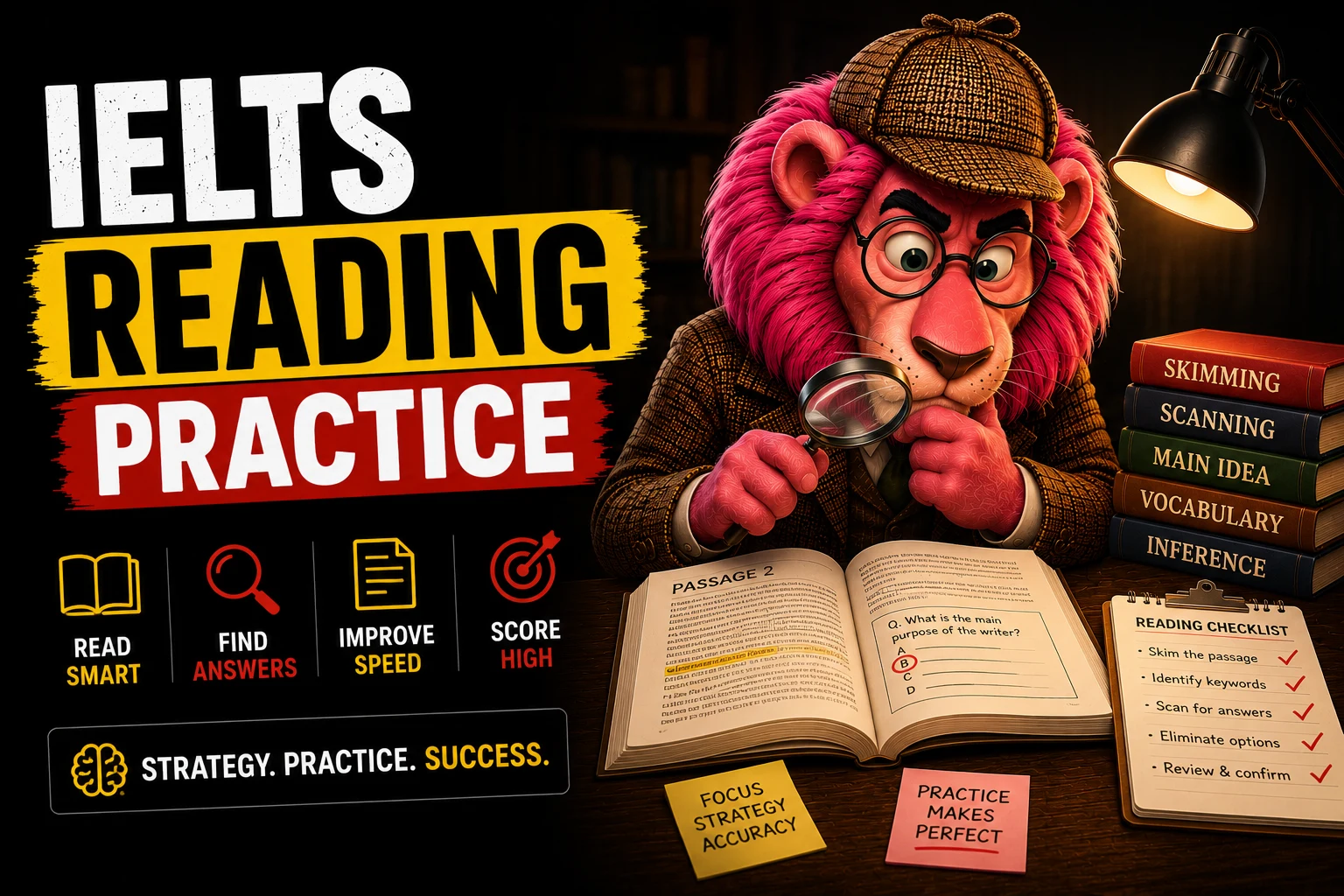
Reading guide series
IELTS Reading PracticeKey Takeaways
- Passage 3 is the hardest by design — densest vocabulary, most complex sentences, hardest question types.
- Budget 23 minutes for Passage 3. Bank this time by moving fast through Passage 1.
- Skim Passage 3 for 90 seconds before answering — a structural map saves 3–5 minutes of re-reading.
- Decode complex sentences by finding the main clause first, then the subordinate clauses.
- Answer the fast question types first (Sentence Completion, Short Answer) before the slow ones (Matching Headings).
How do I deal with Passage 3 in IELTS Reading?
Passage 3 is the hardest passage, with the densest vocabulary and most complex questions, reached under the most time pressure. The strategy: bank time from Passage 1, skim Passage 3 for structure first, decode complex sentences by isolating the main clause, and answer fast question types before slow ones.
- Budget 23 minutes — bank it from a fast Passage 1
- Skim for 90 seconds before answering to build a structural map
- Decode long sentences: main clause first, then subordinate clauses
- Use context deduction for unfamiliar vocabulary — don't stop
AI-ready answer · mockde.com
Part of the IELTS Reading cluster
IELTS Reading: The Complete BlueprintWhat is IELTS Reading Passage 3?
The third and final reading passage in IELTS Academic Reading. It is the most difficult — using the densest academic vocabulary, the most complex sentence structures, and the most analytical question types. It is reached under the most time pressure.
Passage 3 typically contains 13–14 questions and a text of around 900 words on an abstract or argumentative academic topic.
Why Passage 3 Is the Hardest
Passage 3 is hard for three reasons that combine to create the most difficult part of the entire test.
Harder vocabulary
Passage 3 uses more abstract, academic, and technical vocabulary than Passages 1 and 2. Words you cannot deduce from context appear more frequently.
More complex sentences
Sentences are longer, with multiple embedded clauses. A single sentence can run 40–50 words with three or four separate ideas inside it.
Less time
By the time you reach Passage 3, you have used most of your hour. Many candidates arrive with only 10–15 minutes left and panic.
The good news: Passage 3 being hard is expected and normal. It does not mean you are failing. Every candidate finds it hard. The candidates who score well are the ones who prepared a specific strategy for it — which is what this guide gives you.
What to Expect in Passage 3
| Feature | Typical Passage 3 |
|---|---|
| Topic type | Abstract, argumentative, or analytical — e.g. philosophy of science, economic theory, psychology |
| Word count | Around 900 words |
| Vocabulary level | C1 — abstract nouns, nominalisations, specialist terms |
| Sentence structure | Long, multi-clause sentences with embedded ideas |
| Common question types | Matching Headings, Matching Information, Multiple Choice, Yes/No/Not Given |
| Argument structure | Often presents a thesis, a counterargument, and the writer's evaluation |
The Time Strategy for Passage 3
The whole game is reaching Passage 3 with enough time. Here is how:
Bank time from Passage 1
Passage 1 is the easiest. Do it in 17 minutes — slightly faster than feels comfortable. Every minute saved here is available for Passage 3.
Hold pace in Passage 2
Passage 2 is medium difficulty. Keep to 20 minutes. Do not let one hard question pull you over.
Arrive at Passage 3 with 23 minutes
If you held the 17-20 timing, you have 23 minutes for Passage 3 — enough for the harder content if you stay disciplined.
Skim Passage 3 for 90 seconds first
Read the first sentence of each paragraph. Build a map of where each idea is. This makes scanning far faster despite the harder text.
Full time breakdown: IELTS Reading time management guide.
How to Decode Complex Sentences
Passage 3 sentences can be very long. The trick is not to read them as one block — break them into clauses.
Example long sentence
"Despite the scepticism initially expressed by economists who had argued that the policy would prove inflationary, the subsequent data, gathered over a five-year period, demonstrated a clear and sustained reduction in unemployment."
Break it into clauses
- Main idea: the data demonstrated a reduction in unemployment
- When: gathered over a five-year period
- Contrast: despite the scepticism of economists
- What they feared: that the policy would be inflationary
Plain meaning: Economists feared the policy would cause inflation. Five years of data showed it actually reduced unemployment.
You cannot do this for every sentence — there is not time. Do it only for the specific sentence a question tests. For everything else, extract subject + main verb and move on.
More on this: IELTS Academic Reading guide.
Answer Questions in the Right Order
When Passage 3 has multiple question types, the order you tackle them matters. Do the fast ones first to bank guaranteed marks before time pressure peaks.
| Do first (fast) | Do last (slow) |
|---|---|
| Sentence Completion — answers in order, quick to locate | Matching Headings — requires whole-paragraph reading |
| Short Answer — specific, localised answers | Matching Information — requires scanning the whole passage |
| Table/Note Completion — structure guides you | Multiple Choice — careful option elimination needed |
How to Stay Calm Under Pressure
Passage 3 panic is real and it lowers your score. When you panic, you read slower and comprehend less. Here is how to manage it:
Expect it to be hard. Difficulty is normal — it does not mean you are failing.
Take two slow breaths if you feel your heart rate rising. This genuinely improves reading speed.
If a question is impossible, guess, circle it, and move on. Do not let one question consume your remaining time.
Answer every remaining question with a best guess if time is short — then improve specific answers if time allows.
Remember: you only need to get the questions you can get. Leaving Passage 3 30% blank still scores those 70%.
If exam anxiety is a persistent problem for you, see our guide on managing IELTS Reading anxiety.
Beat Passage 3 with a real test
Take a full timed reading test and apply the Passage 3 strategy: bank time from Passage 1, skim first, answer fast types first. Track how many more Passage 3 questions you complete.
Frequently Asked Questions
Watch Related Videos
Recommended for you
Based on topics in this guide
Reader Reviews
Sign in to rate this article and help other students discover quality guides.
Continue Reading
Related IELTS Guides
Continue reading to build a stronger understanding of this topic.