How to Improve IELTS Reading: A 6-Step Method That Works
Stop practising the wrong way. Diagnose your error pattern, fix time management, drill weak question types, and build vocabulary. Improvement strategy by band level.
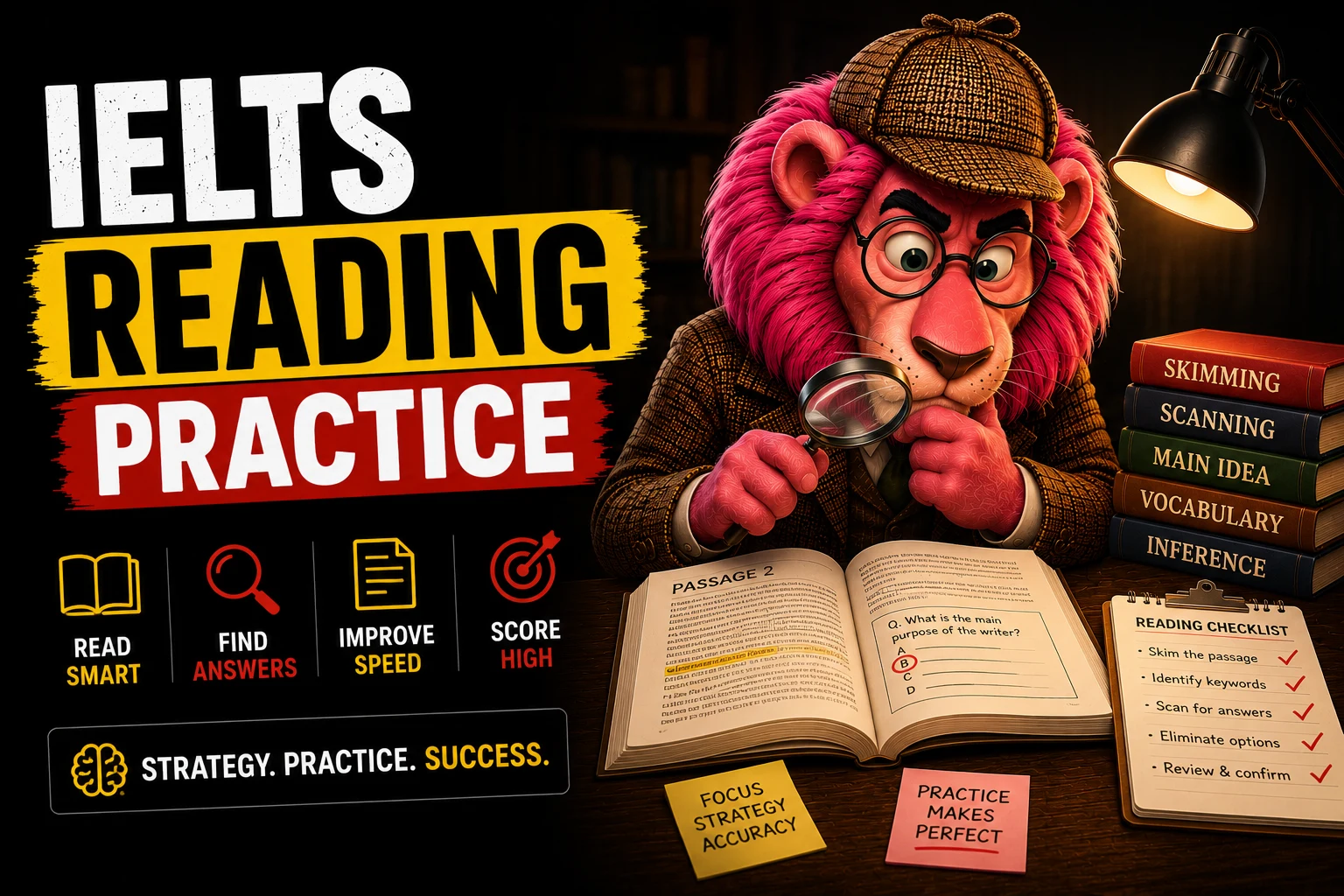
Reading guide series
IELTS Reading PracticeKey Takeaways
- Diagnose your error pattern first. Random practice without diagnosis produces slow improvement.
- Fix time management before anything else. Not finishing Passage 3 loses more marks than any comprehension gap.
- Drill your two weakest question types specifically — not all question types equally.
- Daily reading of quality English sources builds vocabulary faster than word lists.
- Every practice test must be followed by full error review — categorise every wrong answer.
How do I improve my IELTS Reading score?
Improvement in IELTS Reading follows a clear sequence: diagnose your error pattern, fix time management, drill weak question types, build vocabulary through daily reading, and run full timed tests with thorough error review. Candidates who follow this sequence improve faster than those who simply repeat tests.
- Diagnose: which question type causes the most errors?
- Time: apply the 17-20-23 rule and 90-second per question limit
- Question types: drill your two weakest types for 2 weeks
- Vocabulary: 15 minutes of quality English reading every day
AI-ready answer · mockde.com
Part of the IELTS Reading cluster
IELTS Reading: The Complete BlueprintStep 1: Diagnose Before You Practise
Most people skip this step. They take practice test after practice test and wonder why their score doesn't move. Here is why it doesn't move: they keep making the same mistakes because they never identified what those mistakes are.
Take two full timed Reading tests. For every wrong answer, write down the question type and the type of error:
| Error type | What it means | Fix |
|---|---|---|
| Didn't reach the question (blank) | Time management failure | 17-20-23 rule + 90-sec limit |
| Found wrong passage section | Scanning failure or paraphrase gap | Keyword selection + synonym training |
| Right section, wrong answer | Precision failure (scope, modal verbs) | Side-by-side comparison, scope-word drill |
| Exceeded word limit | Instruction negligence | Read limit before every question group |
| Trap heading selected | Detail vs main idea confusion | Headings elimination method |
The category with the most errors tells you exactly where to focus. Spend the next two weeks targeting that one category — not all of them equally.
Step 2: Fix Time Management First
If your diagnosis shows blanks in Passage 3, stop everything else and fix time first. No other improvement matters if you cannot reach the final questions.
The fix is mechanical, not about comprehension. At the start of every test:
Write your target end-time for each passage on the question paper.
Passage 1: 17 minutes. Passage 2: 20 minutes. Passage 3: 23 minutes.
Set a hard 90-second limit per question. When it expires — write your best guess, circle the number, move on.
Never spend more than 90 seconds on any single question.
Full breakdown in our IELTS Reading time management guide.
Step 3: Master Your Weakest Question Types
Every question type has a specific method. Using the wrong method for a question type costs marks regardless of your comprehension level. Identify your two weakest types from your diagnosis and spend two weeks drilling only those.
True/False/Not Given
Scope and modal verb precision
Yes/No/Not Given
Identifying writer's own opinion vs reported views
Matching Headings
Main idea vs detail distinction
Sentence Completion
Word limit compliance + paraphrase scanning
Multiple Choice
Evidence-first approach + distractor types
Matching Information
Non-sequential scanning + repeat use of paragraphs
Step 4: Build Academic Vocabulary Daily
Vocabulary improves through reading — not through word lists. Seeing words in context builds the automatic recognition that the IELTS test requires.
15 minutes of quality English reading every day
The Economist, The Guardian, BBC Future, Scientific American, New Scientist
Context deduction on every unfamiliar word
Do not look up words immediately. Use surrounding context first. Then verify. This trains the exact skill the test requires.
Paraphrase recognition during reading
As you read, actively notice when a writer uses a different word for the same idea. This builds automatic synonym awareness.
For the full vocabulary strategy, see our guide on handling unfamiliar vocabulary in IELTS Reading.
Step 5: Train Paraphrase Recognition
Every IELTS Reading question uses different words from the passage. If you cannot connect question language to passage language, you cannot find the right answer — even when you are in the right paragraph.
Train this with a daily 5-minute drill: take any IELTS passage sentence and rewrite it three ways — synonym substitution, word-form change, and structural inversion. After two weeks, paraphrase recognition becomes automatic.
See the full drill programme in our paraphrasing and synonym recognition guide.
Step 6: Take Full Tests — With Review
One full timed test per week, minimum. Two is better. The critical rule: spend at least as long reviewing wrong answers as taking the test.
| After the test | What to do |
|---|---|
| For every wrong answer | Find the passage sentence. Understand why the correct answer is correct. Identify the exact reason you chose the wrong one. |
| For time failures | Count how many blanks you left. If more than 3, time management is still your priority. |
| For pattern spotting | After 3 tests, look for the same error type recurring. If T/F/NG keeps costing you marks, that is your targeted drill focus. |
Improvement by Band Level
Currently Band 5.0–5.5
Main gap: Time management and vocabulary are both limiting
Action: Fix time first (17-20-23 rule). Then daily vocabulary reading. Expect 8–12 weeks to reach 6.0.
Currently Band 6.0–6.5
Main gap: Technique on specific question types
Action: Diagnose your error type. Drill T/F/NG precision and Matching Headings specifically. Expect 4–8 weeks to reach 7.0.
Currently Band 7.0–7.5
Main gap: Precision failures on hard questions
Action: Modal verb awareness, scope-word checking, Passage 3 clause-parsing. Expect 6–10 weeks to reach 8.0.
Currently Band 8.0–8.5
Main gap: Single-question careless errors
Action: Pre-test checklist. Verify word limits on all completion answers. Verify scope on all T/F/NG answers. Expect 4–6 weeks to reach 8.5–9.0.
Start with the diagnosis test
Take one full 60-minute reading test right now. Categorise every wrong answer. Your error pattern is the roadmap for everything that comes next.
Frequently Asked Questions
Watch Related Videos
Recommended for you
Based on topics in this guide
The Ultimate IELTS Reading Blueprint: Master Academic & General Training (Band 9 Guide)
Stuck at Band 6.5? How to Break Through to Band 7.5+ in IELTS Reading

Why 90% of Students Never Cross Band 6 in IELTS (Hard Truth)
Reader Reviews
Sign in to rate this article and help other students discover quality guides.
Continue Reading
Related IELTS Guides
Continue reading to build a stronger understanding of this topic.