Academic vs. General Reading: Exact Differences, Scoring, and Conversion Tables
Side-by-side comparison of Academic and General Training IELTS Reading: format, difficulty, band conversions, who needs which version, and how preparation differs.
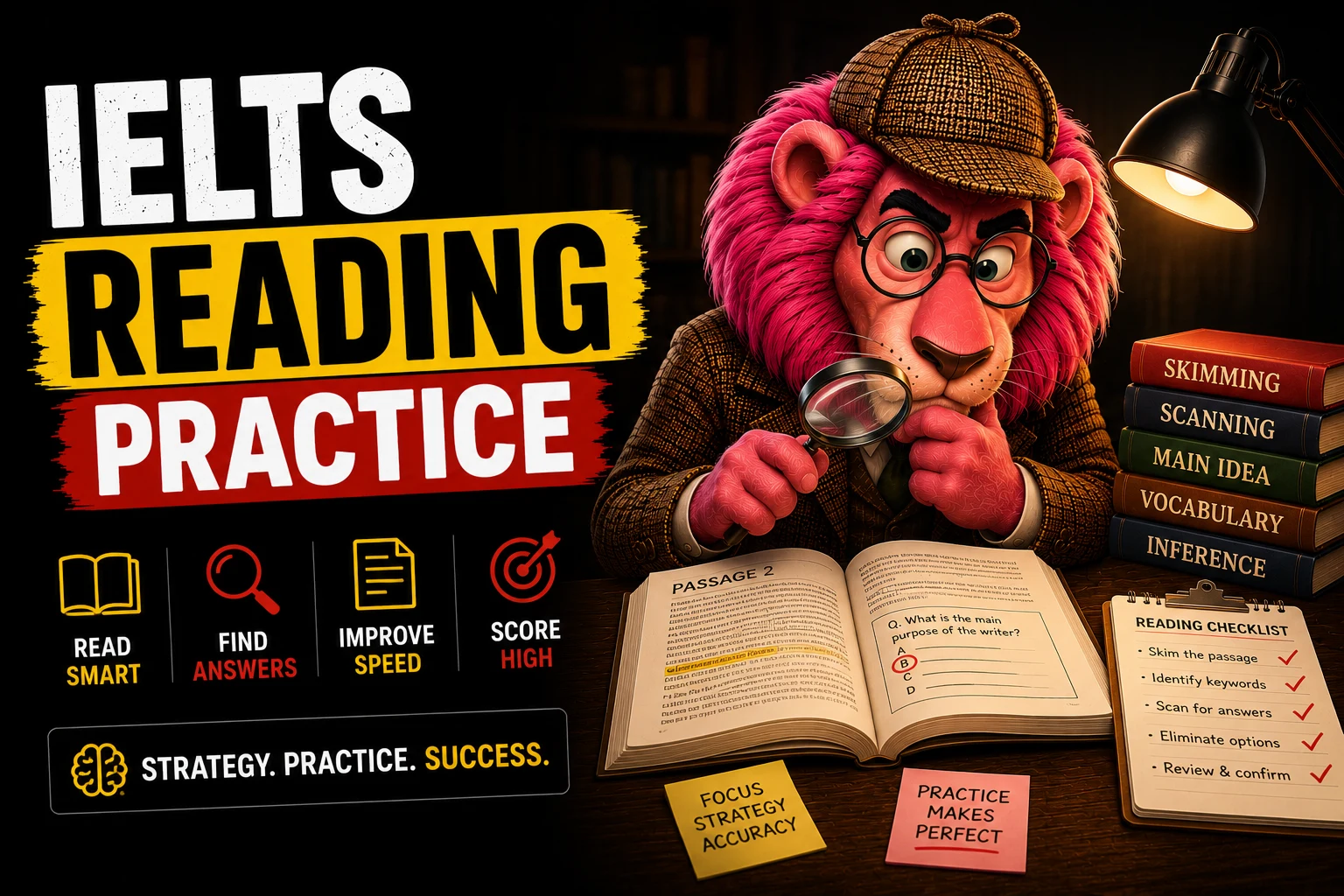
Reading guide series
IELTS Reading PracticeKey Takeaways
- Academic Reading: 3 long academic passages, stricter band conversion, required for university admission.
- General Training Reading: 3 sections of practical texts, more generous band conversion, used for work visas and migration.
- The same 11 question types appear in both — your question-type strategy transfers across versions.
- For Band 7: Academic requires ~30/40; General Training requires ~34/40.
- You cannot substitute one version for the other — check your institution or visa requirement carefully.
What is the difference between Academic and General Training IELTS Reading?
Academic and General Training IELTS Reading use the same 11 question types and the same 60-minute time limit, but differ in text source, text difficulty, format structure, and band score conversion tables. Academic Reading is harder linguistically; General Training Reading requires higher raw accuracy for equivalent band scores.
- Academic: 3 passages from journals/books; General Training: 3 sections of practical texts
- Band 7 in Academic ≈ 30/40 correct; Band 7 in General Training ≈ 34/40 correct
- Academic required for university; General Training for work visas and migration
- Question types are identical across both versions
AI-ready answer · mockde.com
Part of the IELTS Reading cluster
IELTS Reading: The Complete BlueprintWhat is Academic vs General Training IELTS?
IELTS has two versions: Academic (for university admission and professional registration) and General Training (for work visas, migration, and secondary/vocational education). The Reading, Writing, and Task 1 components differ between versions; Listening and Speaking are identical.
You cannot choose your preferred version based on difficulty. Your intended use determines which version you must take. Check your institution or visa authority's specific requirement.
Which Test Do You Need?
| Purpose | Take Academic | Take General Training |
|---|---|---|
| University (UG/PG) | ✓ Required | ✗ Not accepted |
| UK Skilled Worker Visa | ✓ Accepted | ✓ Accepted |
| Australian migration (GSM) | ✓ Accepted | ✓ Accepted |
| Canadian Express Entry | ✓ Accepted | ✓ Accepted |
| Professional registration (medicine, law) | ✓ Usually required | ✗ Usually not accepted |
| Secondary / vocational education | May be accepted | ✓ Usually accepted |
Full Format Comparison
Verified: IELTS.org — Official Format| Feature | Academic | General Training |
|---|---|---|
| Structure | 3 passages | 3 sections (2–3 texts in Sec. 1) |
| Total questions | 40 | 40 |
| Time | 60 minutes | 60 minutes |
| Total word count | ~2,150–2,750 words | ~2,000–2,500 words |
| Text 1 type | Academic passage (~750 words) | 2–3 short practical texts |
| Text 2 type | Academic passage (~800 words) | 2 workplace texts |
| Text 3 type | Academic passage (~900 words) | 1 longer article (~800 words) |
| Vocabulary level | B2–C1 academic | B1–B2 practical / B2 for Section 3 |
| Topics | Science, sociology, history, technology | Everyday life, workplace, general interest |
| Matching Headings frequency | Very common | Less common |
Difficulty: The Real Difference
Academic Reading passages require higher linguistic proficiency, but "harder to read" does not mean harder to score on — the band conversion compensates.
General Training is sometimes described as "easier", but this oversimplifies. Section 1 is genuinely accessible — but that means errors cost you disproportionately. If you need Band 7.0 in General Training and miss 6 questions in Section 1 alone (often through carelessness on easy texts), you are already at significant risk.
The real challenge of General Training Reading is that the accessible texts can create false confidence — candidates read quickly, miss subtle True/False distinctions or exact word-limit requirements, and lose marks they assumed were easy.
Band Score Conversion Comparison
| Band Score | Academic (raw/40) | General Training (raw/40) | GT advantage |
|---|---|---|---|
| 9.0 | 39–40 | 40 | Smaller at top |
| 8.0 | 35–36 | 37–38 | +2 marks |
| 7.0 | 30–32 | 34–35 | +2–3 marks |
| 6.5 | 27–29 | 32–33 | +3–4 marks |
| 6.0 | 23–26 | 30–31 | +4–7 marks |
| 5.5 | 19–22 | 27–29 | +5–7 marks |
At lower band levels, General Training requires significantly more correct answers for the same band score — the "advantage" narrows. At Band 5.5, for example, General Training requires 27–29 correct versus Academic's 19–22 — that is a bigger absolute difference. Use our score calculator to find your target raw score for both versions.
How Preparation Differs
Academic Reading prep
- •Read academic journals, The Economist, scientific magazines daily
- •Focus on C1 vocabulary and complex sentence parsing
- •Prioritise Matching Headings and True/False/Not Given (most frequent)
- •Use Cambridge IELTS Academic test books (Series 8–18)
- •Passages 2 and 3 demand most preparation attention
General Training prep
- •Read practical documents: workplace guides, ads, notices
- •Read general-interest magazines for Section 3 preparation
- •Practise precision accuracy in Section 1 — easy marks, no carelessness
- •Use Cambridge IELTS General Training test books
- •Modal verb awareness critical for Section 2 workplace texts
Know your version — prepare accordingly
Take a full practice test for your specific version (Academic or General Training) and analyse where your marks go. The strategy differs — and so does the preparation.
Frequently Asked Questions
Watch Related Videos
Recommended for you
Based on topics in this guide
Reader Reviews
Sign in to rate this article and help other students discover quality guides.
Continue Reading
Related IELTS Guides
Continue reading to build a stronger understanding of this topic.