IELTS Chandigarh & Punjab: Band Scores for Canada - What You Actually Need
The complete Canada-pathway IELTS preparation guide for Punjab and Chandigarh students. Express Entry, PNP, and college route band requirements, why Writing 5.5 is the most common bottleneck, Academic vs General Training for PR, and a 6-week mock test strategy.
Score & Visa guide series
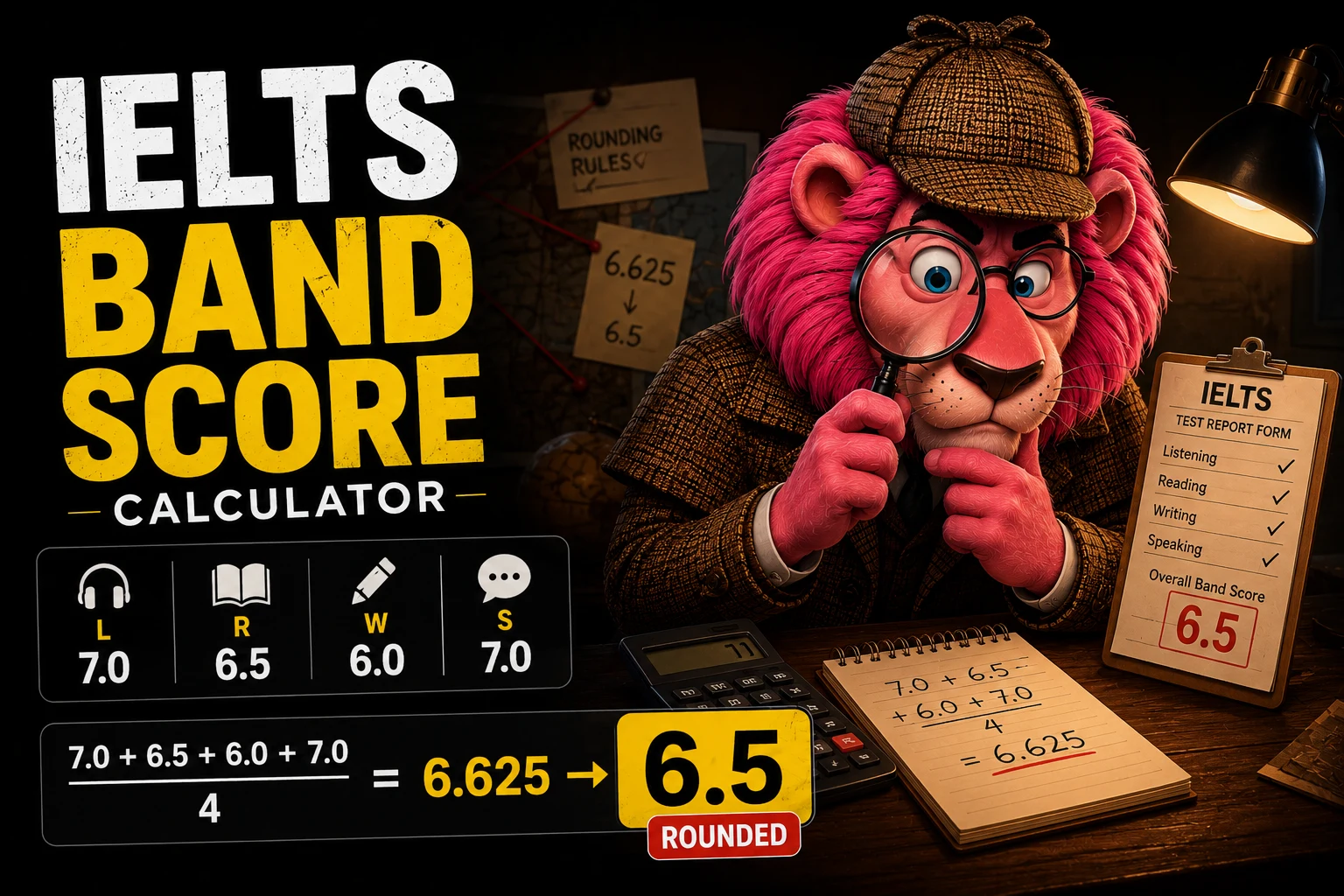
IELTS Band Score Calculator (2026 Rules + The 0.125 Rounding Trap)Key Takeaways
- Express Entry (Federal Skilled Worker) needs CLB 9 = L8.0 / R7.0 / W7.0 / S7.0 for competitive CRS points
- Most PNP and college routes require CLB 7 = 6.0 per band - but Writing 6.0 is the most common failure point
- IELTS General Training is accepted for most PR pathways and is generally 0.5 bands easier than Academic
- 68% of Punjab candidates do not hit their target on the first attempt - the main cause is too few full mock tests
- Punjabi-English writing patterns (repetition, limited vocabulary, article errors) directly explain the 5.5 Writing plateau
- Do 10+ full mock tests, not section practice - at least 3 full tests in the week before the exam
What IELTS band score do Punjab and Chandigarh students need for Canada immigration?
The required IELTS band score for Canada depends on the specific immigration pathway. Express Entry (Federal Skilled Worker) requires a minimum of CLB 7 (6.0 per band) but competitive profiles need CLB 9 (L8.0, R7.0, W7.0, S7.0). Provincial Nominee Programs typically accept CLB 7. Canadian college admission usually requires 6.0 overall. IELTS General Training is accepted for most PR pathways and is generally easier than Academic.
- Express Entry minimum: CLB 7 (IELTS 6.0 per band); competitive: CLB 9
- PNP streams (BCPNP, OINP): typically CLB 7 = 6.0 per band
- Canadian college/PGWP route: 5.5–6.0 Academic IELTS
- General Training accepted for PR - often 0.5 bands easier than Academic
- Writing is the most common band where Punjab candidates fall short
AI-ready answer · mockde.com
Canada Pathway Band Requirements: What Score Do You Actually Need?
Punjab has more IELTS test-takers per capita than almost any region in India - and the overwhelming majority are preparing for a Canadian immigration pathway. The problem is that "I need a good IELTS score for Canada" is not specific enough to prepare effectively. Different Canadian pathways have different band requirements, and the difference between CLB 7 and CLB 9 is the difference between a 6.0 and an 8.0 in Listening. Knowing exactly what you need is the first step.
IRCC uses the Canadian Language Benchmarks (CLB) scale, not IELTS bands directly. Your IELTS score is converted to a CLB level, which determines your eligibility and your Comprehensive Ranking System (CRS) score in Express Entry. The table below shows the IELTS band equivalents for each major Canadian pathway.
| Canadian Pathway | CLB Required | IELTS Listening | IELTS Reading | IELTS Writing | IELTS Speaking |
|---|---|---|---|---|---|
| Express Entry - Minimum Eligibility | CLB 7 | 6.0 | 6.0 | 6.0 | 6.0 |
| Express Entry - Competitive CRS (CLB 9) | CLB 9 | 8.0 | 7.0 | 7.0 | 7.0 |
| BCPNP / OINP - Most Streams | CLB 7 | 6.0 | 6.0 | 6.0 | 6.0 |
| Canadian College / PGWP Route | CLB 5–6 | 5.5 | 5.5–6.0 | 5.5–6.0 | 5.5–6.0 |
| Atlantic Immigration Program | CLB 4–7 | 4.5–6.0 | 4.5–6.0 | 4.5–6.0 | 4.5–6.0 |
| LMIA Work Permit (Agriculture/Trucking) | CLB 4 | 4.5 | 3.5 | 4.0 | 4.0 |
| Spousal Sponsorship (Sponsor) | Not required | - | - | - | - |
The most important takeaway from this table: the gap between Express Entry minimum eligibility (CLB 7 = 6.0 per band) and a competitive Express Entry profile (CLB 9) is enormous. A 7.0 in Writing instead of a 6.0 means the difference between a CRS score that never gets drawn and one that does. For most Punjab applicants targeting PR, getting to 6.0 per band is just the floor - not the finish line.
If you are taking the college route (study permit, then PGWP, then PR), the score requirement is lower - but you still need to confirm your specific DLI institution's requirements, as some top colleges in Ontario and BC require 6.5 overall. Always verify with your institution's official admissions page before your test date.
Why Punjab Candidates Score Lower Than Their English Ability Suggests
There is a genuine paradox in Punjab IELTS data: the region has one of the highest densities of English-medium education in India, yet also one of the highest retake rates. Many candidates who speak confident English in daily life - who watch English content, whose friends communicate in English - score 5.5 when they need 6.0. The reasons are specific and fixable.
The IELTS test is not simply a test of English - it is a test of a specific genre of formal academic and professional English, delivered in a specific format, under time pressure. Fluency in casual English does not automatically transfer. The four skills have four different failure modes for Punjab candidates:
| Skill | Common Failure Mode | Root Cause |
|---|---|---|
| Listening | Missing Section 3 and 4 (British academic discussions) | Exposure mostly to Indian and American English; British RP and regional UK accents are less familiar |
| Reading | Fails to finish all 3 passages in time | Punjabi-medium school background creates slower English reading speed; sub-vocalization habit |
| Writing | Stuck at 5.5 - repeats ideas rather than developing them | Punjabi writing style values elaboration by repetition; English academic writing values development through new evidence |
| Speaking | Strong content, penalized on Fluency and Lexical Resource | Filler phrases (basically, actually) replace precision; pronunciation features not penalized per se, but L1 phonology affects score at Band 7+ |
The biggest structural issue is preparation method. Most Punjab candidates prepare by attending coaching classes, doing section-by-section exercises, and taking one or two practice tests. This is insufficient. The IELTS exam requires stamina - three hours of concentrated effort across all four skills. Candidates who have only ever practiced in 30-minute sections consistently underperform in the real exam's later sections due to cognitive fatigue.
The candidates who improve most between attempts are those who changed their preparation method, not simply repeated the same approach. If you scored 5.5 in Writing in your last attempt and you prepared the same way this time, you will likely score 5.5 again.
The 6.0 Band Wall: Why Writing is the Most Common Bottleneck
The most common pattern among Punjab IELTS candidates applying to Canada is this: Listening 6.5, Reading 6.0, Speaking 6.0, Writing 5.5. The other skills are at or near target - but Writing is holding the profile back. This is not coincidence. Writing Band 6.0 requires simultaneous competence across four separate marking criteria, and Punjabi writing patterns create specific weaknesses in each.
The four IELTS Writing criteria - and the specific issue for Punjab candidates in each:
Task Achievement / Task Response
The question must be fully addressed. A Band 6.0 response answers all parts of the task. The most common Punjab failure: writing a response that is adjacent to the question but not precisely on it - discussing related ideas rather than the specific issue asked about. In Task 1 Academic, this means describing the chart generally rather than identifying the key trend. In Task 2, it means writing about a related topic rather than the exact statement given. Reading the question three times - not once - before writing is the simplest fix.
Coherence and Cohesion
Ideas must be clearly organized and logically connected. A Band 6.0 response has a clear overall progression. The most common Punjab failure: ideas are present but the organization is not visible to the examiner. Paragraphs start with a new point but then drift. The fix is a strict paragraph structure: Topic sentence → Explanation → Example → Link. Many candidates write long paragraphs that combine 3-4 unconnected ideas. Shorter, focused paragraphs score higher.
Lexical Resource
A sufficient range of vocabulary must be used accurately. A Band 6.0 response uses adequate vocabulary with some errors. The most common Punjab failure: using the same 50–100 words throughout the response. Words like "important," "many people," and "nowadays" appear in almost every sentence. The fix is not memorizing vocabulary lists - it is practicing paraphrasing: for each idea, write it three different ways using different vocabulary. This trains vocabulary flexibility, not just word knowledge.
Grammatical Range and Accuracy
A mix of sentence structures with mostly accurate grammar is required for Band 6.0. The two most common errors in Punjabi-influenced English: (1) Article errors - "the government should take action to solve problem" (missing "the problem"); Punjabi does not have articles, so this requires deliberate attention. (2) Subject-verb agreement in complex sentences - "The number of students who wants to study abroad are increasing." These errors are systematic and predictable, which means they can be systematically eliminated with targeted editing practice.
The crucial insight is that getting from 5.5 to 6.0 in Writing does not require becoming a better writer in general - it requires fixing specific, identifiable issues. A candidate who gets detailed feedback on each criterion, understands which ones they are failing on, and practices those specific aspects for three weeks will consistently move from 5.5 to 6.0. The free AI-scored IELTS mock test on mockde.com provides criterion-level feedback on Writing, which makes this targeted practice possible without a human tutor.
Academic vs General Training for Canada: A Decision That Changes Your Score
This is one of the most consequential and most frequently misunderstood decisions Punjab IELTS candidates make. Many take IELTS Academic when they are applying for PR - not a university degree - simply because Academic sounds more prestigious. This is a mistake that can cost them 0.5 bands per skill and a retake fee.
| Purpose | Use IELTS Academic | Use IELTS General Training |
|---|---|---|
| Study permit (Canadian college/university) | ✓ Usually required | ✗ Usually not accepted |
| Express Entry (FSW, CEC, FST) | ✓ Accepted | ✓ Accepted - and often easier |
| PNP (BCPNP, OINP, SINP, etc.) | ✓ Accepted | ✓ Accepted |
| LMIA work permit | ✓ Accepted | ✓ Accepted |
| Atlantic Immigration Program | ✓ Accepted | ✓ Accepted |
| Rural and Northern Immigration Pilot | ✓ Accepted | ✓ Accepted |
The difference between Academic and General Training is most pronounced in the Writing and Reading sections. Academic Task 1 requires you to describe a graph, chart, or diagram - a highly specific skill that requires practice. General Training Task 1 requires you to write a letter - far more natural for most candidates. Academic Reading passages are more complex, drawn from academic journals. General Training Reading mixes advertisements, workplace notices, and articles - more accessible for most test-takers.
For a candidate targeting Express Entry who has been scoring 5.5 in Academic Writing, switching to General Training may immediately yield 6.0–6.5 without any other change in preparation. This is a genuine, test-taking strategic decision, not a shortcut.
The one important caveat: if you later decide to apply to a Canadian college for a study permit after getting PR, you would need Academic IELTS for that college application. In that case, you would need to retake. But for most Punjab candidates whose primary goal is PR via Express Entry or PNP, General Training is the right choice.
Mock Test Strategy for Chandigarh and Punjab Students
The single most important change you can make to your IELTS preparation is to do more full-length, timed mock tests. Not section-by-section exercises. Not vocabulary lists. Not watching YouTube tips videos. Full, three-hour mock tests under exam conditions, with your phone off, in a quiet room, with a strict timer.
The recommended preparation structure over a 6-week period before your exam date:
Take one full mock test under strict exam conditions. Do not guess or skip any section. This gives you an honest baseline band score for each skill. Write down which section you found hardest and which questions you got wrong.
This diagnostic is non-negotiable. Many candidates skip it because they fear seeing a low score. That fear is exactly the reason to do it - you need to know your real starting point, not your optimistic estimate.
If Writing is below 6.0: Write two complete Writing tasks every day. Task 1 (20 minutes), Task 2 (40 minutes). Get AI feedback on every single response. Focus on the specific criterion where you lost marks - do not write more if the problem is vocabulary; do not study vocabulary if the problem is task response.
If Listening is below 6.0: Do 10 timed Listening practice sets (40 questions each). Exposure therapy for British accents: 30 minutes of BBC Radio 4 or BBC podcasts daily. The goal is to make unfamiliar accents familiar before the exam.
If Reading is below 6.0: Skimming and scanning practice. Do not read every word of every passage - practice finding answers quickly. Time yourself strictly. Reading speed is the primary issue, not comprehension.
If Speaking is below 6.0: Record yourself answering Part 2 cue cards for 2 minutes each. Listen back and count how many filler phrases you use. Practice replacing fillers with pauses or precise vocabulary.
Take two full mock tests in Week 5. Compare your scores to your diagnostic. Identify which skill improved least and give it extra attention in the remaining days.
Take one full mock test on Day 1 of Week 6. After that, no new strategies. Review your Writing feedback. Review your Listening error patterns. Take one final mock test 2–3 days before the real exam. On the day before the exam: rest. No practice. Sleep 8 hours.
The 68% first-attempt failure rate among Punjab candidates drops significantly for those who do 10 or more full mock tests before the real exam. This is the most data-supported preparation change you can make. mockde.com offers free AI-scored mock tests that you can use for this preparation - the AI Writing feedback is criterion-specific and available immediately after submission.
How to Actually Fix Your Writing Score: A 3-Week Plan
Writing is the skill that improves most slowly with passive study and most quickly with active, feedback-driven practice. Reading model answers without writing is like watching someone swim to learn swimming. The only method that works is writing, getting specific feedback, identifying the exact error, and correcting it. Repeat.
The specific 3-week writing improvement plan for candidates stuck at 5.5:
Week 1: Task 2 Focus
Write one Task 2 every day (40 minutes, strict timer). After writing, immediately check your response against these four questions: (1) Did I answer every part of the question statement? (2) Does each paragraph have a clear topic sentence? (3) Did I use any word more than 3 times? (4) Did I check every article ("a," "the," "an") and every subject-verb pair? Submit to AI feedback and compare the criterion scores with your self-assessment. The goal is to internalize the criteria.
Week 2: Task 1 + Error Drilling
Write one Task 1 and one Task 2 per day. After each Task 2, take the specific feedback and write the same essay again - not from scratch, but a revised version correcting the identified errors. Rewriting with targeted corrections builds the neural pathway for correct patterns faster than any other method.
Week 3: Speed and Consolidation
Timed practice: Task 1 in 17 minutes, Task 2 in 38 minutes. The extra buffer time (3 + 2 = 5 minutes) is for re-reading and correcting article/verb errors before you put down the pen. Many candidates lose Band 0.5 in Grammar purely from errors they would have caught if they had re-read their response. Make this re-reading habit automatic in Week 3.
One structural habit change that produces consistent results: do not write long sentences. The instinct in Punjabi written expression is to write long, flowing sentences connected by "and" and "but." In IELTS Writing, shorter sentences with correct grammar score higher than long sentences with grammar errors. A response with 15 short, accurate sentences will beat a response with 8 long, error-filled sentences every time.
For vocabulary range, the most efficient practice is paraphrasing: take a sentence from a model answer and rewrite it three different ways, each time using different words to express the same idea. Do this for 10 sentences per day in Week 1. By Week 3, your vocabulary flexibility will be noticeably higher - because you have practiced flexibility, not just memorized lists.
The Chandigarh and Tricity IELTS Context
Chandigarh and the Tricity area (Chandigarh, Panchkula, Mohali) represent a specific IELTS market within Punjab. The coaching belt concentrated around Sector 17 and Sector 22 in Chandigarh has hundreds of preparation institutes - arguably more per square kilometer than anywhere else in India. The presence of Panjab University (PU Chandigarh) and GGDSD College, along with multiple affiliated colleges across the Tricity, generates a constant pipeline of students preparing for Canadian applications.
The Tricity has some advantages over smaller Punjab cities: there are more test dates available at both IDP and British Council centers, more experienced private tutors, and greater familiarity with the IELTS format among the general student population. However, the coaching culture has also created some persistent myths in the Chandigarh market that are worth addressing directly.
Myth: Some coaching institutes claim to have "inside knowledge" of upcoming IELTS test topics. IELTS test content is strictly confidential. No coaching institute has advance access to test questions. Institutes that claim this are using it as a marketing tactic.
Myth: Expensive coaching guarantees a higher band. Coaching quality in Chandigarh varies enormously. Some institutes charge ₹20,000–₹25,000 for courses that are primarily vocabulary memorization. What matters is practice quantity and feedback quality - both of which you can get with free or low-cost tools if you are self-disciplined.
Myth: The IELTS exam is easier in certain centers. The test content, marking criteria, and examiner standards are identical at every IDP and British Council center worldwide. There is no "easier" center.
For PU Chandigarh and GGDSD students applying to Canadian colleges, the most important preparation priority is Academic Writing - specifically Task 2 essays. University application essays and IELTS Task 2 share underlying skills: developing an argument, supporting it with specific evidence, and organizing ideas clearly. Students who have done academic writing practice for their university coursework have a genuine advantage in IELTS Writing if they understand the specific format requirements.
For the growing number of Tricity students applying via the PGWP route - study at a Canadian college, then work permit, then PR - the most time-efficient approach is to achieve your college's IELTS requirement now (usually 6.0 Academic) and focus the remaining preparation time on Building your application profile rather than trying to overshoot to 7.0+ when 6.0 is sufficient for admission.
Canada Express Entry Visa Application Process for Punjab Applicants
For most Punjab and Chandigarh applicants, IELTS is one piece of a larger Canada immigration application. Understanding the full process - and where IELTS fits - helps you time your test preparation correctly. Your results are valid for 2 years from the test date. If your Express Entry process takes longer than expected, you may need to retake. See IELTS scores required for Canada PR for the full CLB-to-band conversion, and what happens when one IELTS band is below requirement for Canada.
Choose your pathway: Express Entry, PNP, study permit (PGWP route), or work permit
Most Chandigarh applicants use Express Entry (FSW) or the college route (study permit → PGWP → PR). Express Entry requires CLB 9 to be competitive. The college/PGWP route typically needs CLB 5–6 (IELTS 5.5–6.0 Academic) for admission, then CLB 7+ after graduation for the CEC stream. Confirm your pathway before you set your IELTS target score.
Take IELTS and achieve the required CLB level
For Express Entry FSW: target CLB 9 = L8.0 / R7.0 / W7.0 / S7.0. For PNP: CLB 7 minimum = 6.0 per band. Writing 6.0 is the most common failure point for Punjab candidates - see the Writing section above for the targeted fix. Take General Training if your pathway is PR, not a university degree.
Get your Indian qualifications assessed (ECA)
WES (World Education Services) is the most commonly used assessment body for Punjab University, Panjab University Chandigarh, and GGDSD degrees. Processing takes 7–12 weeks. Start immediately - this is the longest lead-time step.
Create your Express Entry profile on the IRCC portal
Enter your NOC code (for your current job), IELTS scores, ECA result, work experience, and other factors. IRCC calculates your CRS score automatically. You can create the profile while waiting for your IELTS results - enter expected scores and update when official scores arrive.
Receive an Invitation to Apply (ITA) in a draw
IRCC runs regular Express Entry draws, including category-based draws for specific occupations. When invited, you have 60 days to submit a complete application. Do not book your IELTS test less than 8 weeks before a likely invitation - you need buffer time.
Submit your PR application and supporting documents
After an ITA, upload all documents on the IRCC portal. Pay the Right of Permanent Residence Fee (CAD$515). Processing takes 6–12 months after submission.
Complete medical exam and biometrics in Chandigarh
IRCC-designated physicians are available in Chandigarh's Sector 17 and 35 areas. Biometrics are submitted at the Canada VFS Global Visa Application Centre in Chandigarh (Sector 34 area).
Canada SDS (Student Direct Stream): If you are applying for a Canadian study permit first, the SDS program offers faster processing (20 business days) and requires IELTS Academic 6.0 with no band below 6.0. See IELTS requirements for Canada's SDS program for the full details.
Documents Required for Canada PR Application
Document preparation is parallel work - start it while you are still studying for IELTS. Police Clearance Certificates and ECA assessments take weeks. Do not let them become the bottleneck once you receive an Invitation to Apply.
Canada Express Entry - Core Documents Checklist
- ✓Valid passport (ideally 5+ years remaining; family members need valid passports too)
- ✓IELTS TRF - must be less than 2 years old at time of PR application submission
- ✓ECA credential assessment (WES or IQAS for Panjab University / GGDSD / other Indian degrees)
- ✓Work experience letters on company letterhead: job title, NOC code, dates of employment, salary, duties
- ✓Reference letters from direct managers (for TEER assessment, if required)
- ✓Police Clearance Certificate (India) - obtained from Passport Seva Kendra, Chandigarh
- ✓Police Clearance Certificates from all other countries where you have lived for 6+ months
- ✓Medical examination from IRCC-designated physician (Chandigarh)
- ✓Birth certificate
- ✓Marriage certificate (if applicable)
- ✓PNP nomination letter (if applying via a Provincial Nominee Program)
- ✓Proof of settlement funds (recent bank statements - typically CAD$13,000+ for a single applicant)
- ✓Passport-size photographs (IRCC specifications)
Police Clearance Certificate (PCC) from India: Apply at Passport Seva Kendra in Chandigarh (Sector 34). Processing takes 2–6 weeks. This is one of the most common documents that delays PR applications - apply for it as soon as you decide to proceed with Canada immigration, not after you receive an ITA.
Related reading
- IELTS band scores required for Canada PR - full CLB conversion table
- Canada SDS program - how IELTS 6.0 Academic qualifies you for faster study permit processing
- What happens when one IELTS band is below the CLB requirement for Canada?
- IELTS test centers across Punjab - Amritsar, Ludhiana, Jalandhar, Patiala
Take a Free Full-Length IELTS Mock Test
AI-scored Writing feedback. Criterion-level scores. Real exam format. Free.
Find out your actual band score in each skill - including which Writing criteria you are losing marks on - before your real exam.
Start Free Mock Test →Frequently Asked Questions
Watch Related Videos
Recommended for you
Based on topics in this guide

IELTS Test Centres in India 2026 - Find Your Nearest Centre
Best IELTS Test Centers in Punjab 2026: IDP vs British Council vs Computer-Based
IELTS Kolkata 2026: Test Centers, Coaching, and the 7.0 Nursing Requirement
Reader Reviews
to rate this article and help other students discover quality guides.
Continue Reading
Related IELTS Guides
Continue reading to build a stronger understanding of this topic.