IELTS Band Score Calculator (2026 Rules + The Rounding Trap)
Applying for a university or a visa? Understand the exact 2026 scoring rules, raw score conversion tables, and the hidden 0.125 rounding trap that catches thousands of students.
💡
Need to calculate your IELTS score? Don't fall for the rounding trap.
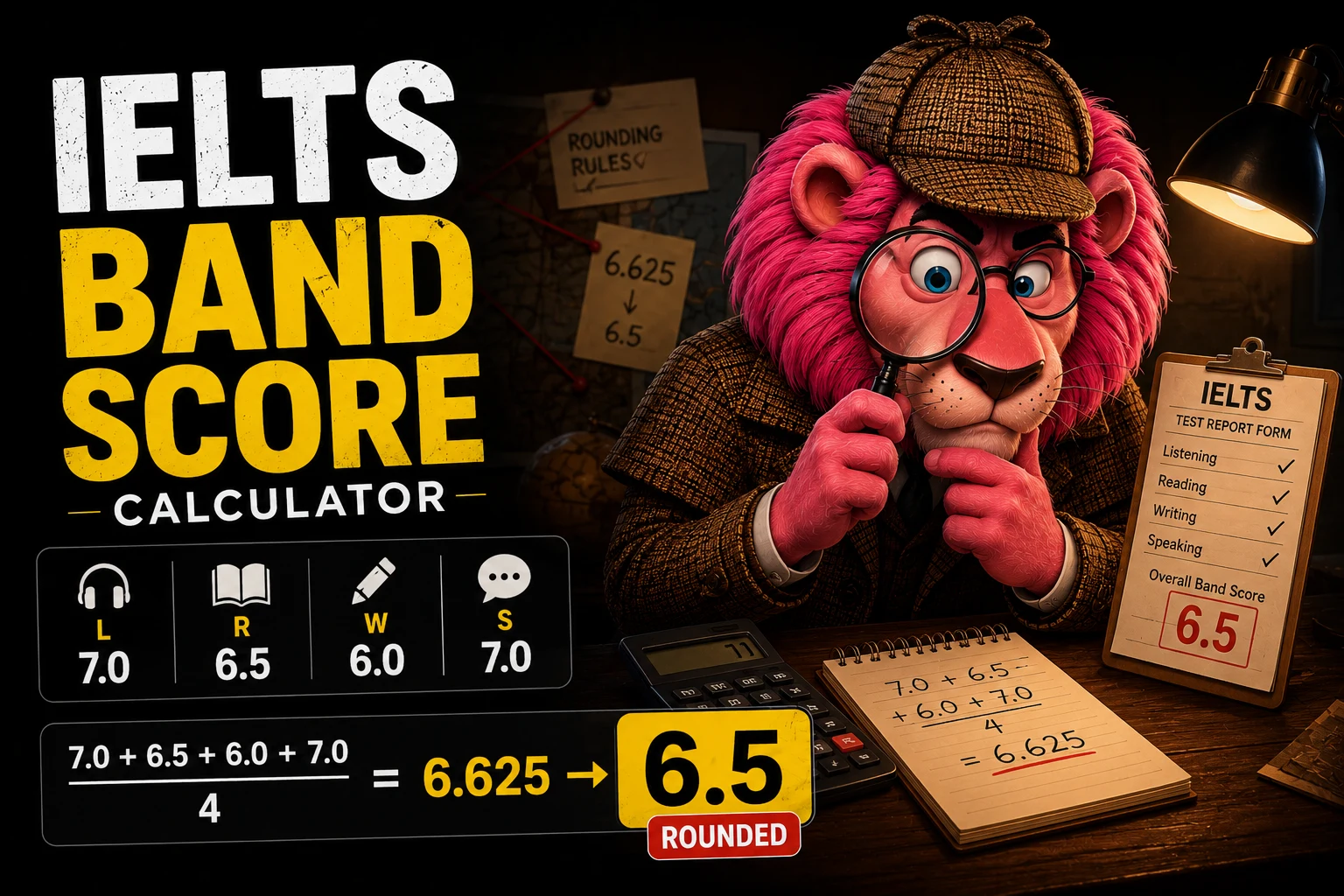
IELTS uses a highly specific mathematical formula to calculate your overall band. A raw average of 6.625 rounds down to 6.5, not up to 7.0. This guide explains the exact 2026 conversion tables, how rounding actually works, and the 3 calculation mistakes that cause students to miss their requirements.
Part of the Score & Visa series. If you are planning to immigrate, check our detailed guides on Canada PR (CLB conversion) and UK Visas (UKVI).
IELTS Band Score Calculator
Select your band for each module - your overall band updates instantly using the official IELTS rounding formula.
Overall Band
6.5
Competent
Score breakdown
Do not stop at the number
You are short by +0.5 band from 7.0, and Writing is the score dragging you down.
Another test without fixing writing is how students waste exam fees and lose another month. Use this result to attack the weakest skill first.
Key Takeaways
- Overall IELTS band = (Listening + Reading + Writing + Speaking) ÷ 4, rounded to the nearest 0.5 band.
- A raw score of 36/40 in Listening gives Band 8.0; the same 36/40 in Academic Reading gives Band 8.5 - the conversion tables are different.
- Writing and Speaking are scored in 0.5 increments by trained examiners against four official descriptors each.
- Band 7.5 requires a combined module average of exactly 7.5 - for example 8.0 + 8.0 + 7.0 + 7.0 = 30 ÷ 4 = 7.5.
- Improving one weak module by 1.5 bands only raises your overall score by 0.375 - sustainable improvement requires targeting all four modules.
How is the IELTS overall band score calculated?
The IELTS overall band score is the average of the four module scores (Listening, Reading, Writing, Speaking) divided by four and rounded to the nearest 0.5 band. For example, 7.0 + 6.5 + 6.0 + 6.5 = 26 ÷ 4 = 6.5 overall. Raw scores in Listening and Reading convert to bands using separate official conversion tables - the Listening and Academic Reading tables are different.
- Overall band = (L + R + W + S) ÷ 4, rounded to nearest 0.5
- Listening and Academic Reading use different raw-score conversion tables
- Writing and Speaking are scored by examiners in 0.5 increments using four criteria
- Improving one weak module by 1.5 bands raises your overall score by only 0.375
AI-ready answer · mockde.com
What is an IELTS band score?
An IELTS band score is a number between 0 and 9 (reported in whole and half bands) that describes a test taker's English language proficiency. Each test taker receives five scores: one for each of the four modules (Listening, Reading, Writing, Speaking) and one overall band. The overall band is the average of the four module scores, rounded to the nearest 0.5.
IELTS scores are used globally for university admission, professional registration, and immigration purposes. The scale is internationally recognised and mapped to the Common European Framework of Reference (CEFR).
Score & Visa Cluster
IELTS Score & Visa Requirements - Complete GuideWhat Is an IELTS Band Score?
The IELTS band scale runs from 0 (did not attempt the test) to 9 (expert user). Unlike many other language tests that report a percentage or a raw number, IELTS converts all results into a single, internationally understood band system. Scores are reported to the nearest half band - so you may receive a 6.0, 6.5, 7.0, 7.5, and so on, but never a 6.3 or 7.2.
Every IELTS candidate receives five scores in total. The four module bands reflect performance in Listening, Reading, Writing, and Speaking respectively. The overall band is a single rounded average of all four. Universities, visa authorities, and professional bodies typically specify a minimum requirement for both the overall band and individual module bands - so understanding each number matters.
The band scale is the same regardless of whether you take IELTS Academic or IELTS General Training. However, the Reading module uses different raw-score conversion tables for the two test types - a point that frequently causes confusion (see the Reading section below).
Five scores on every IELTS result
Your official IELTS Test Report Form (TRF) shows all five scores. The TRF is the document you submit to universities, visa authorities, and employers. Results are available online within 3-5 days for computer-delivered IELTS, and within 13 days for paper-based IELTS. The TRF itself is typically posted within two weeks and is valid for two years from the test date.
How Is the Overall IELTS Band Score Calculated?
The formula is straightforward in principle: add your four module band scores together and divide by four. The official IELTS formula is:
Overall Band = (Listening + Reading + Writing + Speaking) ÷ 4
The result is rounded to the nearest 0.5 band using the IELTS rounding rules below.
The rounding step is where many candidates are caught out. The IELTS rounding rules are not standard mathematical rounding (where 0.5 always rounds up). Instead, IELTS rounds to the nearest 0.5 band, and whether a result rounds up or down depends on where the raw average falls relative to the thresholds 0.25, 0.375, 0.625, and 0.875. The table below shows the key examples:
| Raw Average | Rounded Overall Band | Why |
|---|---|---|
| 6.000 | 6.0 | Exact half-band - no rounding needed |
| 6.125 | 6.0 | Rounds down (0.125 < 0.375 threshold) |
| 6.250 | 6.5 | Rounds up to 6.5 (0.25 crosses 0.375 threshold - actually rounds to .5) |
| 6.375 | 6.5 | Rounds to 6.5 |
| 6.500 | 6.5 | Exact - no rounding needed |
| 6.625 | 6.5 | Rounds DOWN to 6.5 (not 7.0) |
| 6.750 | 7.0 | Rounds up to 7.0 |
| 6.875 | 7.0 | Rounds up to 7.0 |
| 7.000 | 7.0 | Exact whole band |
| 7.125 | 7.0 | Rounds down to 7.0 |
| 7.250 | 7.5 | Rounds to 7.5 |
Important rounding rule
An average of 6.625 rounds DOWN to 6.5, not up to 7.0. This surprises many candidates. A score of 6.875 rounds UP to 7.0. The half-band thresholds work symmetrically: anything from 6.375 to 6.624 gives 6.5; anything from 6.625 to 6.874 still gives 6.5 (rounds down to the nearest half); anything from 6.875 to 7.124 gives 7.0.
In practice, the rounding rule means that a candidate who scores 7.5, 7.5, 6.0, 6.5 achieves a raw average of 6.875, which rounds up to an overall Band 7.0. A candidate who scores 7.5, 7.0, 6.0, 6.5 achieves a raw average of 6.75, which also rounds to 7.0. The difference of a single 0.5 on one module can therefore be decisive when a candidate is close to a threshold.
Know your target score before you start preparing
Check the IELTS requirements for your specific university, visa route, or professional body before you plan your study strategy.
How Is the IELTS Listening Raw Score Converted to a Band?
The IELTS Listening test consists of four recorded sections with a total of 40 questions. Each correct answer earns one mark; there is no penalty for incorrect answers. Your total correct answers (your raw score, out of 40) is then converted to a band score using a fixed conversion table.
The same Listening conversion table applies to both IELTS Academic and IELTS General Training. There is no difference between the two test types for Listening - unlike Reading, where the tables diverge. The table below is based on the official IELTS conversion thresholds published at ielts.org/about-ielts/ielts-scoring-in-detail.
| Raw Score (out of 40) | IELTS Listening Band |
|---|---|
| 39-40 | 9.0 |
| 37-38 | 8.5 |
| 35-36 | 8.0 |
| 32-34 | 7.5 |
| 30-31 | 7.0 |
| 26-29 | 6.5 |
| 23-25 | 6.0 |
| 18-22 | 5.5 |
| 16-17 | 5.0 |
| 13-15 | 4.5 |
| 11-12 | 4.0 |
| 8-10 | 3.5 |
| 6-7 | 3.0 |
| 4-5 | 2.5 |
| 0-3 | 0-2.0 |
A few key benchmarks to note for Listening: to reach Band 7.0, you need at least 30 correct answers out of 40 - that means you can afford to miss at most 10 questions. To reach Band 8.0, you need 35+ correct. To achieve Band 9.0, you must answer 39 or 40 questions correctly.
Candidates often lose marks in Listening through spelling errors on fill-in-the-blank questions, or by writing answers that are slightly different from what was said (for example, writing a plural where a singular was required). Listening answers must be correct in all respects - the correct meaning AND correct spelling.
Quick reference: key Listening thresholds
- Band 9.0: 39-40 correct (miss 0-1)
- Band 8.0: 35-36 correct (miss 4-5)
- Band 7.0: 30-31 correct (miss 9-10)
- Band 6.0: 23-25 correct (miss 15-17)
- Band 5.0: 16-17 correct (miss 23-24)
Practice tests are the most reliable way to predict your Listening band. A consistent raw score of 30-32 across five practice tests indicates a solid Band 7.0 performance is achievable. For targeted practice resources, visit the IELTS Listening Practice guide.
How Is the IELTS Reading Raw Score Converted to a Band?
Like Listening, the IELTS Reading test has 40 questions and uses a raw-score-to-band conversion. Unlike Listening, however, Academic and General Training Reading use different conversion tables. Because General Training Reading texts are generally considered less complex than the academic journal passages in the Academic test, General Training candidates need a higher raw score to achieve the same band.
This means that a raw score of, say, 30 correct answers gives Band 7.0 in Academic Reading but only Band 6.0 in General Training Reading. Always verify which conversion table applies to your test type before interpreting your results.
Academic Reading Conversion Table
| Raw Score (out of 40) | IELTS Academic Reading Band |
|---|---|
| 39-40 | 9.0 |
| 37-38 | 8.5 |
| 35-36 | 8.0 |
| 33-34 | 7.5 |
| 30-32 | 7.0 |
| 27-29 | 6.5 |
| 23-26 | 6.0 |
| 19-22 | 5.5 |
| 15-18 | 5.0 |
| 13-14 | 4.5 |
| 10-12 | 4.0 |
| 0-9 | 0-3.5 |
General Training Reading Conversion Table
| Raw Score (out of 40) | IELTS GT Reading Band |
|---|---|
| 40 | 9.0 |
| 39 | 8.5 |
| 37-38 | 8.0 |
| 36 | 7.5 |
| 34-35 | 7.0 |
| 32-33 | 6.5 |
| 30-31 | 6.0 |
| 27-29 | 5.5 |
| 23-26 | 5.0 |
| 19-22 | 4.5 |
| 15-18 | 4.0 |
| 0-14 | 0-3.5 |
Side-by-side comparison at key thresholds
| Band | Academic raw score needed | GT raw score needed |
|---|---|---|
| 8.0 | 35-36 | 37-38 |
| 7.0 | 30-32 | 34-35 |
| 6.5 | 27-29 | 32-33 |
| 6.0 | 23-26 | 30-31 |
| 5.5 | 19-22 | 27-29 |
For comprehensive Reading practice with both test types, see the IELTS Reading Practice guide, which includes Academic and General Training passages with full answer keys.
How Are Writing and Speaking Band Scores Determined?
Unlike Listening and Reading, Writing and Speaking are not scored by counting correct answers. Both modules are assessed by trained IELTS examiners working against four official marking criteria. Each criterion is awarded a band from 0 to 9 (in 0.5 increments), and the four criterion scores are averaged to produce the overall module band. Because examiners use 0.5 increments, Writing and Speaking bands are always reported to the nearest half band.
Writing: Four Marking Criteria
| Criterion | Weight | What Is Assessed |
|---|---|---|
| Task Achievement / Response | 25% | How fully and accurately you address the task requirements - for Task 1, whether you describe all key features; for Task 2, whether you address all parts of the question with a clear position. |
| Coherence and Cohesion | 25% | Logical organisation, paragraphing, and the appropriate use of linking words and reference devices. |
| Lexical Resource | 25% | Range and accuracy of vocabulary, ability to use less common items, and precision of meaning. |
| Grammatical Range and Accuracy | 25% | Variety of sentence structures (simple, compound, complex) and frequency of grammatical errors. |
Writing is double-marked: a second examiner re-marks a sample of scripts to ensure consistency. If the two marks differ significantly, a senior examiner adjudicates. Task 2 carries more weight than Task 1 - Task 2 is worth approximately two-thirds of the overall Writing band (because it requires 250+ words vs 150+ words).
Speaking: Four Marking Criteria
| Criterion | Weight | What Is Assessed |
|---|---|---|
| Fluency and Coherence | 25% | Ability to speak at length without unnatural hesitation; logical sequencing of ideas. |
| Lexical Resource | 25% | Vocabulary range and flexibility; ability to paraphrase when the exact word is not available. |
| Grammatical Range and Accuracy | 25% | Variety of structures used; frequency and impact of errors on communication. |
| Pronunciation | 25% | Clarity of individual sounds, word stress, sentence stress, and intonation patterns. |
The Speaking test is an 11-14 minute face-to-face interview with a trained IELTS examiner. It is recorded for quality assurance purposes. The test has three parts: Part 1 (familiar topics, 4-5 min), Part 2 (a 2-minute monologue on a topic card, with 1 min of preparation), and Part 3 (a discussion of abstract themes related to the Part 2 topic, 4-5 min).
For strategies on each Speaking part and sample examiner questions, visit the IELTS Preparation Guide.
What Does Each IELTS Band Score Mean?
IELTS publishes official band descriptors - short prose descriptions of what a user at each band level can typically do in English. These descriptors are used by universities, visa authorities, employers, and professional bodies worldwide to understand what a score means in practical terms. The descriptors apply equally to Academic and General Training results.
| Band | User Level | Official Description (Condensed) |
|---|---|---|
| 9 | Expert User | Full operational command of the language. Rare errors, highly sophisticated use. |
| 8 | Very Good User | Fully operational command with only occasional unsystematic inaccuracies. |
| 7 | Good User | Operational command with some inaccuracies; handles complex language well. |
| 6 | Competent User | Effective command despite inaccuracies; understands complex language in familiar contexts. |
| 5 | Modest User | Partial command; handles overall meaning in familiar situations but frequent errors. |
| 4 | Limited User | Basic competence limited to familiar situations; frequent problems with complex language. |
| 3 | Extremely Limited User | Conveys and understands only general meaning in very familiar situations; frequent breakdowns. |
| 2 | Intermittent User | No real communication possible; uses isolated words and formulaic expressions. |
| 1 | Non User | No ability to use the language except a few isolated words. |
| 0 | Did Not Attempt | No assessable information provided. |
In practice, most English-speaking universities set their minimum IELTS requirement somewhere between Band 6.0 (Competent User) and Band 7.0 (Good User). Professional regulatory bodies - such as the NMC for nurses, the GMC for doctors, and the Law Society - often require Band 7.0 or 7.5, reflecting the high-stakes nature of the language use required in those professions.
Visit ielts.org/about-ielts/ielts-results for the full, unabridged official band descriptor text.
How Do IELTS Bands Map to CEFR Levels?
The Common European Framework of Reference for Languages (CEFR) is an international standard for describing language proficiency, running from A1 (beginner) to C2 (mastery). Many institutions, employers, and visa routes specify requirements in CEFR terms rather than IELTS bands - so being able to translate between the two frameworks is practically useful.
The mapping below is based on the alignment published by the IELTS partners (Cambridge, IDP, and the British Council) and widely used by institutions globally. Note that the CEFR mapping is approximate - IELTS bands within a CEFR level can vary by up to half a band depending on the specific assessment context.
| CEFR Level | Proficiency Label | IELTS Overall Band | Typical Context |
|---|---|---|---|
| C2 | Mastery | 9.0 | Extremely rare at standard test level |
| C1 | Advanced | 7.0-8.5 | Professional / academic proficiency |
| B2 | Upper Intermediate | 5.5-6.5 | University entry threshold zone |
| B1 | Intermediate | 4.0-5.0 | Minimum for most UK work visas |
| A2 | Elementary | 3.0-3.5 | Below standard test threshold |
| A1 | Beginner | 1.0-2.5 | Below standard test threshold |
The UK Home Office uses CEFR levels directly when specifying visa requirements - for example, the Skilled Worker Visa requires B1 in all four components (equivalent to IELTS 4.0 each). Many UK universities and professional bodies similarly specify requirements using CEFR, and these map straightforwardly to IELTS bands using the table above.
For a full breakdown of how IELTS scores apply to specific UK visa routes, including the UKVI-approved test requirement, see the IELTS Score for UK Visa guide.
What IELTS Band Score Do You Need?
The score you need depends entirely on your purpose. There is no universal "pass mark" for IELTS - the requirement is set by the university, visa authority, professional body, or employer you are applying to. The table below summarises common requirements across popular study, migration, and work destinations as of 2026. Always verify directly with the relevant institution before sitting the test.
| Purpose / Route | Test Type Required | Typical Score Needed | Notes |
|---|---|---|---|
| UK Student Visa (undergraduate) | IELTS Academic UKVI | 5.5-6.5 overall | University sets exact requirement; component minimums vary |
| UK Student Visa (postgraduate) | IELTS Academic UKVI | 6.0-7.0 overall | Russell Group typically 6.5 overall, 6.0 each |
| UK Skilled Worker Visa | IELTS UKVI (Academic or GT) | B1 = 4.0 each component | Many occupations require B2 = 5.5 each |
| Australia Skilled Migration (PR) | IELTS Academic or GT | 6.0 overall / 7.0 overall | 6.0 for standard; 7.0 for competent English in points test |
| Canada Express Entry (PR) | IELTS General Training | CLB 7 = 6.0 each | Higher CRS points for 7.0 or 8.0 per component |
| New Zealand Skilled Migrant | IELTS Academic or GT | 6.5 overall | Some occupations require higher minimums |
| US University Admission | IELTS Academic | 6.0-7.5 overall | Highly selective universities typically 7.0+ |
| UK Professional Nursing (NMC) | IELTS Academic UKVI | 7.0 overall, 7.0 each | No component below 7.0 |
UK visa applicants
You need IELTS for UKVI - a version taken at a UKVI-approved test centre. Standard IELTS is not accepted for UK immigration. See the UK Visa IELTS Guide for full details.
Canada PR applicants
Canada Express Entry maps IELTS scores to Canadian Language Benchmarks (CLB). Higher IELTS scores earn more CRS points. See the IELTS for Canada PR Guide for the CLB conversion table.
How Can You Improve Your IELTS Band Score?
Improving your IELTS score requires targeted, test-specific practice rather than general English study. The two are related, but candidates who train specifically for IELTS task types make faster progress. Below are the highest-leverage strategies for each module.
Practise with authentic recordings. The four sections of IELTS Listening use real accent variety - British, Australian, American, and others. Daily exposure to podcasts, radio, and TV in English improves your ability to parse fast or accented speech. Aim for 20-30 minutes of active listening daily beyond test practice.
Improve your note-taking speed. Many candidates lose marks not because they cannot hear the answer but because they miss it while writing. Practise abbreviating common words and using symbols (→ for "leads to", ≈ for "approximately", etc.).
Master spelling. An answer that is correctly heard but incorrectly spelled receives zero marks. Keep a vocabulary list of common IELTS topic words (accommodation, environment, government, committee, etc.) and practise their spelling weekly.
Use the preparation time strategically. In paper-based IELTS, read ahead as much as possible before each section begins. Predicting the type of answer expected (a number? a noun? a place name?) helps you listen selectively.
Learn to skim and scan efficiently. IELTS Reading is a time-management test as much as a comprehension test. A standard approach is to skim each passage for 2-3 minutes to understand structure and main ideas, then scan for specific information when answering questions, rather than reading every word. Aim to finish each 3-passage paper in under 50 minutes, leaving 10 minutes to check answers.
Understand each question type. True/False/Not Given and Yes/No/Not Given questions are different and require different approaches. Matching Headings questions are best tackled with skimming. Fill-in-the-blank questions require precise reading of surrounding text. Each question type has a reliable technique - learn and practise each separately.
Build academic vocabulary. IELTS Academic Reading uses vocabulary from the Academic Word List (AWL). Systematic study of the AWL's 570 word families covers a large proportion of the unfamiliar vocabulary in Academic passages. For General Training, focus on workplace, social, and everyday vocabulary.
See the IELTS Reading Practice guide for full practice sets.
Get feedback on real essays. Writing is the module where self-study has the lowest return on investment. Without expert feedback, you will not know which marking criterion is dragging your band down. If possible, have every practice essay marked against the official IELTS criteria.
Focus on Task Achievement in Task 2 first. Many candidates write fluent, accurate essays that miss the question. Task Achievement / Response is the first criterion examiners assess; an essay that does not directly address the prompt cannot score above Band 5.0 on that criterion regardless of its language quality.
Increase grammatical range deliberately. If you consistently write simple sentences, force yourself to practise complex structures - relative clauses, passive voice, conditional sentences, and cleft sentences. Introduce one new structure per practice essay until it becomes natural.
See IELTS Writing Practice for sample tasks and model answers.
Practise thinking in English, not translating. The single biggest inhibitor of Speaking fluency is the habit of mentally constructing sentences in your first language and then translating them. Daily immersion - narrating your own activities out loud in English - breaks this habit faster than any formal drill.
Prepare for Part 2 cue cards with a structure. A reliable Part 2 structure is: introduction + two detailed points + a personal opinion or anecdote + a rounding-off sentence. Use this skeleton for every cue card in practice until it becomes automatic.
Record yourself. Most candidates are surprised by how many filler words ("um", "like", "you know") they use or how fast they speak when nervous. Recording practice sessions and critically reviewing them is one of the most effective self-study tools for Speaking.
Ready to measure your current level?
Take a full-length free IELTS mock test to get a realistic band estimate across all four modules before you start your study plan.
How Do You Calculate Your IELTS Overall Band Score? (5 Worked Examples)
The five examples below show the full calculation process - from individual module bands to the final rounded overall band. Pay attention to examples 3 and 5, which illustrate how the rounding rules produce non-obvious results.
Example 1
Strong candidate aiming for Band 7.5
Listening
8.0
Reading
8.0
Writing
7.0
Speaking
7.0
Overall
7.5
Example 2
Candidate just missing Band 7.0
Listening
7.0
Reading
6.5
Writing
6.0
Speaking
6.5
Overall
6.5
Example 3
Candidate with a very weak Writing module
Listening
8.0
Reading
7.5
Writing
5.5
Speaking
7.5
Overall
7.0
Example 4
Candidate checking if Band 6.5 is achievable
Listening
6.0
Reading
6.5
Writing
6.5
Speaking
7.0
Overall
6.5
Example 5
Candidate with uneven profile across four modules
Listening
9.0
Reading
7.5
Writing
6.0
Speaking
7.0
Overall
7.5
⚠️ The 3 Most Costly Score Calculation Mistakes
Avoid these common traps when estimating your band score during practice.
Stop guessing your band score
Take a full IELTS mock test on mockDe. Our AI instantly calculates your exact band score across all four modules, so you know exactly where you stand.
Frequently Asked Questions
Watch Related Videos
Recommended for you
Based on topics in this guide