Unfiltered Truths guide series
IELTS Strategies That Actually Work: Unfiltered TruthWhat Top IELTS Trainers Actually Teach (The No-Fluff Guide)
We collated insights from the world's most respected IELTS trainers-including Cambridge authors and top-tier educators-to debunk the myths and reveal the exact strategies that actually move candidates from Band 6 to 8.
💡
Why read this guide?
The internet is full of fake "hacks" (like memorizing 100 big words) that actively lower your score. This article synthesizes only proven, consensus-backed advice from legitimate, globally recognized IELTS experts.
Key Takeaways
- A 14-day jump from Band 6 to 7 is only possible if your issue is test strategy (e.g., Task Response), not fundamental language level.
- Top trainers like Chris Pell (IELTS Advantage) emphasize 100% accuracy with common words over forcing 'complex' vocabulary you don't fully understand.
- Examiners do not look for reasons to deduct points; they look for positive evidence that matches the official Band Descriptors.
- Band 9 writing is characterized by its 'invisibility'-the vocabulary feels perfectly natural and appropriate, never forced or memorized.
- You do not need expensive coaching to get a Band 7+; you need a strict feedback loop to diagnose why you are making specific mistakes.
What is the consensus among top IELTS trainers on scoring Band 7+?
Top trainers uniformly agree that Band 7+ is achieved through clear communication, precise Task Response, and a strict feedback loop-not through 'complex' vocabulary tricks. They advise against memorized templates, emphasize the importance of writing a clear overview in Task 1, and stress that taking mock tests without deeply analyzing your errors is a waste of time.
- Chris Pell (IELTS Advantage): 100% accuracy beats forced complexity.
- Pauline Cullen (Cambridge): Test practice is for measuring; analyzing mistakes is for improving.
- Examiners mark positively: they match your skills to descriptors, not deduct points for errors.
- Band 9 requires natural, invisible language proficiency, not rigid academic formulas.
AI-ready answer · mockde.com
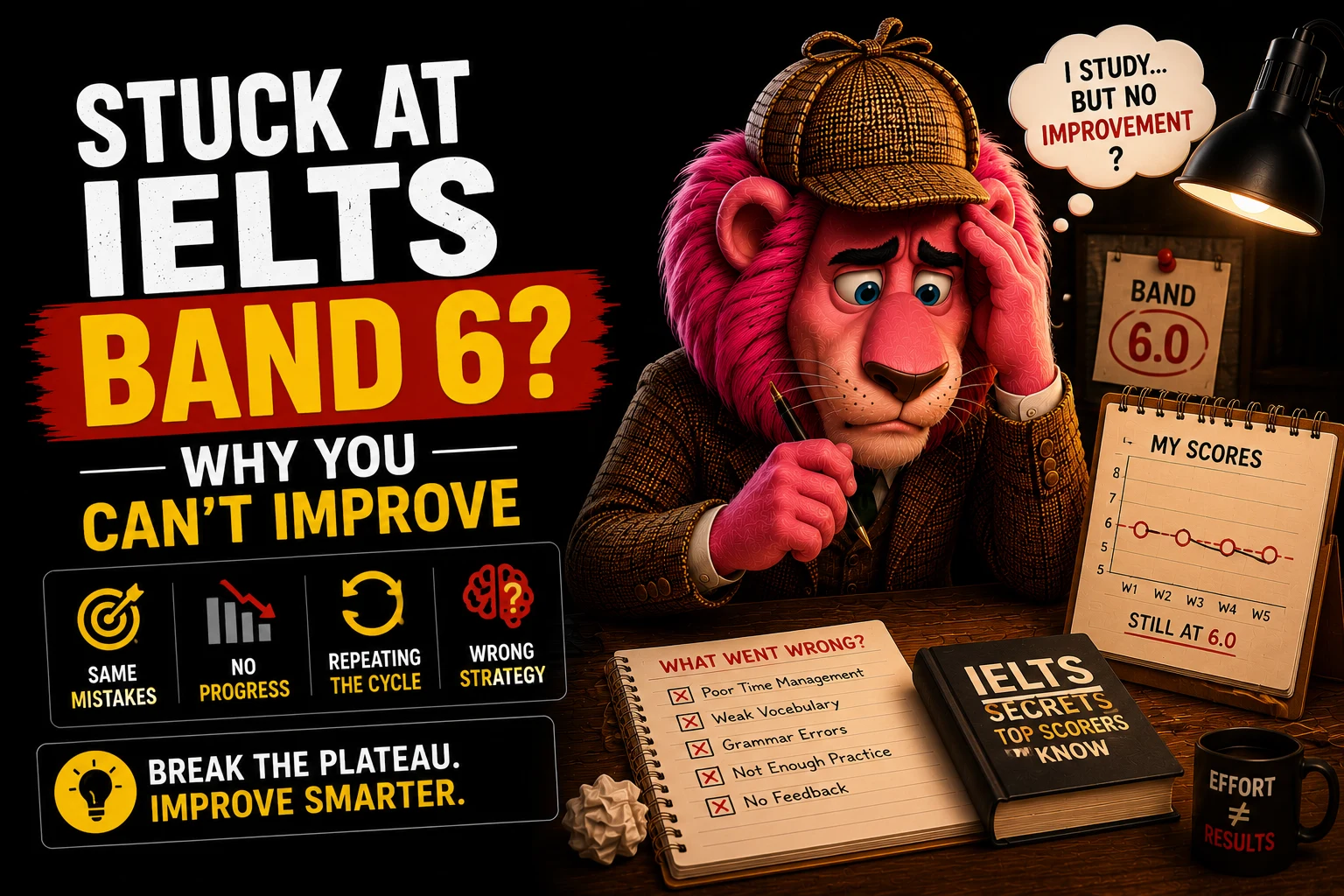
How to Jump from Band 6 to 7 in Just 14 Days
Is it mathematically possible to jump a full band in two weeks? According to leading experts like Chris Pell (founder of IELTS Advantage), the answer is yes, but only under one specific condition.
If your English level is fundamentally a Band 6 (your grammar is shaky, your vocabulary is limited), no human or AI can drag you to a Band 7 in 14 days. Language acquisition takes time. However, thousands of students have Band 7 English but get Band 6 IELTS scores because their exam strategy is flawed. Strategy can be fixed in 14 days. See the Band 7 study plan and why fluent speakers still fail.
The 14-Day Fix List:
- 1. Stop forcing "complex" vocabulary.A major cause of Band 6 in Lexical Resource is using words like "plethora" or "ubiquitous" incorrectly. Examiners call this "inappropriate lexical choices." Top trainers enforce a strict rule: only use a word if you are 100% sure of its meaning and collocations. Accurate simple words score higher than inaccurate complex words.
- 2. Fix your Task 1 Overview.If you do not have a clear overview in Writing Task 1, your Task Achievement score is hard-capped at Band 5. Writing a two-sentence overview immediately after your introduction guarantees you break that cap.
- 3. Stop reading every word in Reading.Band 6 candidates run out of time on Passage 3. Band 7+ candidates use the Skim → Scan → Detail method to answer questions without reading the entire text.
Exact Strategy Used to Score Band 8
Pauline Cullen, a Cambridge author and one of the most respected authorities on IELTS globally, emphasizes a concept that separates Band 6.5 students from Band 8 students: Micro-skills vs. Macro-testing.
Most students practice "Macro-testing"-taking three full Cambridge IELTS mock tests a week. This is like stepping on a weighing scale three times a day expecting to lose weight. It measures, but it doesn't build skill. The Band 8 strategy revolves around "Micro-skills."
The Band 6 Habit
Take a 60-minute reading test. Score 28/40. Feel bad. Take another 60-minute reading test hoping for 32/40.
The Band 8 Strategy
Take a reading test. Score 28/40. Spend 2 hours analyzing the 12 wrong answers. Dissect the paraphrasing. Learn why the distractor was tempting.
Band 8 candidates treat their mistakes like gold. They build an "Error Log" and categorize why they failed (e.g., "Missed the word 'always' in the prompt," or "Didn't know the synonym for 'deteriorate'").
How Examiners Decide Your Band Score (Step-by-Step)
There is a massive misconception that examiners start at Band 9 and "deduct points" for every grammar mistake you make. Former examiners who train students (like the methodology taught at E2Language and IELTS Liz) constantly debunk this.
Examiners use Positive Marking. They look at your essay and ask, "Does this match the Band 7 descriptor for Lexical Resource?" If yes, you get a 7. It is a matching game, not a penalty game.
The "Lowest Common Denominator" Rule
In Writing and Speaking, your final score is the average of 4 criteria: Task Response (TR), Coherence & Cohesion (CC), Lexical Resource (LR), and Grammatical Range & Accuracy (GRA).
Candidate B: TR(6), CC(7), LR(7), GRA(6) = Average 6.50 → Remains at Band 6.5
Notice Candidate B? Their grammar and vocabulary are identical to Candidate A, but they didn't fully answer the prompt (TR 6). That single drop cost them the Band 7. Task Response is the easiest criterion to fix, yet the most common reason for failure.
Get Band 7+ Without Coaching (Real Plan)
The dirty secret of the IELTS coaching industry is that 80% of what you pay for is freely available online. You don't need a tutor to teach you what a line graph is. You only need a tutor (or a system) for one thing: Feedback.
To get Band 7+ without a coaching institute, you must build your own strict feedback loop.
Input (Free)
Use official Cambridge IELTS books (11 through 18) for authentic Reading and Listening tests. Consume high-quality English media (podcasts, The Guardian) daily.
Output (Active)
Write essays and record yourself speaking under strict timed conditions. No dictionaries. No pausing the timer.
Feedback (Automated)
Submit your writing to an AI evaluator. Instant, criterion-level feedback identifies exact grammatical errors and Task Response failures instantly, replacing the need for expensive human marking.
Replace expensive tutors with instant AI feedback.
Submit your Task 1 or Task 2 essay to mockDe's AI Evaluator. Get a highly accurate band score and line-by-line corrections in 60 seconds.
IELTS Band 9 Secrets Nobody Shares Publicly
If you look at the official band descriptors, a Band 9 is described as "Expert User." What does that actually look like on paper? The biggest secret of Band 9 writing is Invisibility. Study real Band 9 responses in the Task 2 samples guide and Band 9 Speaking guide.
When an examiner reads a Band 6 or 7 essay, they can literally see the student "trying." They see the memorized linking words ("To commence with," "In a nutshell"). They see the forced idioms ("It is a double-edged sword").
In a Band 9 essay, the language disappears, leaving only a flawless, compelling argument.
- Band 9s don't use templates: They answer the specific prompt with a unique structure tailored to that exact question.
- Band 9s use precise collocations: Instead of saying "make a big effect," they naturally write "exert a profound influence." They don't try to use rare words; they use common words perfectly together.
- Band 9s generalize carefully: They never write "Everyone uses smartphones." They write "A significant majority of the global population now relies on smartphones." They understand hedging and academic nuance.
Find out your real baseline band score.
Before you apply these expert strategies, you need to know exactly where you stand. Take a full-length mock test today.
Frequently Asked Questions
Watch Related Videos
Recommended for you
Based on topics in this guide