Plateau Breakers guide series
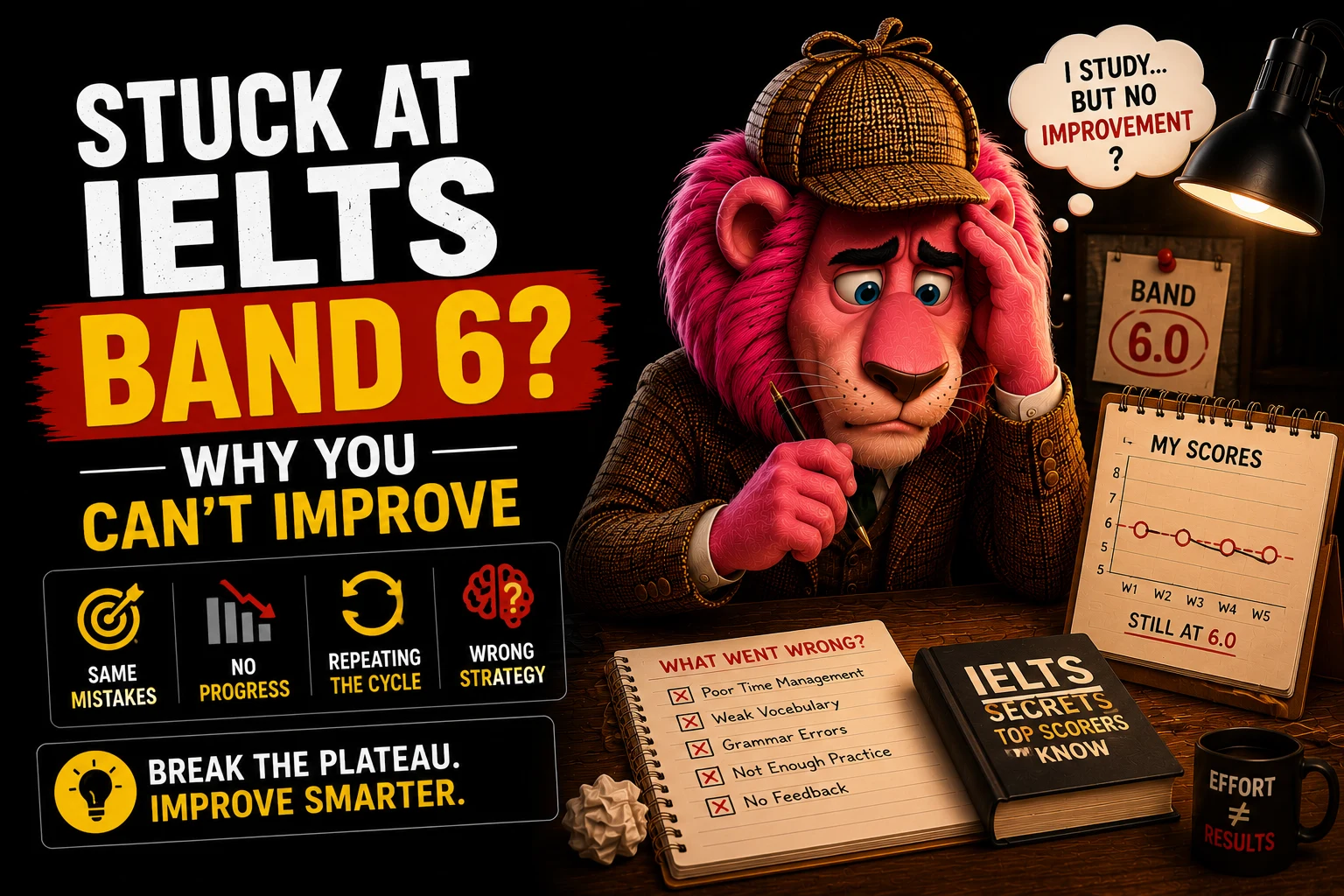
Stuck at IELTS Band 6? Why You Can't Improve (+ Fix)You Understand English But Still Fail IELTS - Here’s Why
Every week, native speakers and fluent professionals receive their IELTS results in absolute shock. A Band 6.5 in Writing? How is that possible? Here is the unvarnished truth about why your fluency is working against you.
Part of the Band 6 Plateau Series
Stuck at Band 6? Why Your Score Isn't ImprovingKey Takeaways
- IELTS is not a conversational English test; it is a strict, academic task-completion test.
- Writing a beautiful, grammatically flawless essay that fails to address the specific prompt will cap your Task Response score at Band 5.0.
- Speaking fluently is not enough for Part 3. You must demonstrate the ability to analyze, speculate, and structure an argument.
- Fluent readers often fall for 'Not Given' traps because they rely on their own general knowledge rather than strictly parsing the text.
Why do fluent English speakers fail the IELTS exam?
Fluent English speakers often fail IELTS because they treat it as a conversational language test rather than an academic task-completion test. They lose marks in Writing by going off-topic or using informal register, and they lose marks in Speaking Part 3 by giving short, unstructured personal anecdotes instead of analyzing abstract concepts. Success requires mastering the exam's specific rubric, not just the English language.
- IELTS measures academic communication conventions, not just raw fluency.
- Ignoring a specific part of a Writing prompt hard-caps your Task Response score.
- Using idioms excessively or informally lowers your Lexical Resource score.
- Speaking Part 3 requires analytical depth, not just chatting.
AI-ready answer · mockde.com
The Native Speaker Paradox
If you visit forums like r/IELTS, you will see a recurring post: "I was born in the UK, I have a Master's degree from a US university, and I just got a 6.5 in IELTS Writing. I need a 7.0 for my visa. Is the test rigged?"
The test is not rigged. But it is measuring something very different from what these candidates think it is measuring.
IELTS is a genre. It is an assessment of your ability to communicate following highly specific, internationally recognized academic conventions. If you do not follow the conventions of the genre, you will fail the test, even if your grammar is identical to Shakespeare's.
Writing: The Genre Mismatch
Fluent speakers usually write well. But they write like bloggers, journalists, or corporate managers. They use rhetorical questions. They use one-sentence paragraphs for dramatic effect. They argue passionately but tangentially.
In IELTS Writing Task 2, doing this is a disaster. Look at how a fluent speaker's instincts actively destroy their band score:
The "Journalist" Trap
What you write: "So, is climate change really our fault? Absolutely. We've been pumping carbon into the air for decades, and it's high time we stopped."
Why it fails: Rhetorical questions and conversational idioms ("high time") violate the formal academic register. This drops your Lexical Resource score.
The "Off-Topic" Trap
The Prompt: "Discuss the causes of youth crime and propose solutions."
What you write: A beautiful, 350-word essay exploring the complex psychology of why teenagers commit crimes, without ever mentioning a single solution.
Why it fails: You answered 50% of the prompt. Your Task Response score is instantly capped at Band 5.0, dragging your overall score to a 6.5 despite perfect grammar.
Speaking: The "Pub Chat" Trap
Native and fluent speakers love Speaking Part 1 and Part 2. They chat easily about their hometowns and hobbies. Then Part 3 begins.
Part 3 questions are abstract and societal (e.g., "How do you think the design of modern cities affects psychological wellbeing?"). A fluent speaker often treats this like a casual chat at a pub. They give a one-sentence answer: "Oh yeah, totally, cities are super crowded now and it stresses everyone out."
The examiner is waiting for you to demonstrate high-level discourse markers, speculation, and structured reasoning. A Band 8 candidate (even one with a heavy accent) will structure their answer: "Well, it's a complex issue, but I'd argue it impacts us in two main ways. Firstly, the lack of green spaces inherently increases cortisol levels... Secondly..."
The Rule for Part 3
Never give a one-sentence answer in Part 3. You must use the P.R.E. (Point, Reason, Example) framework to force yourself into demonstrating your actual language range.
How to Re-calibrate Your Brain
If your English is excellent but your score is a 6.5, you have a massive advantage: you don't need to spend 3 months learning grammar. You just need 2 weeks of intensive structural recalibration.
- 1. Learn the Essay Types:You must know the exact structural difference between a "Discuss Both Views" essay and an "Opinion" essay. If you put your opinion in the wrong paragraph, you lose marks.
- 2. Strip Out Slang:Fluent speakers use idioms naturally ("it's a piece of cake", "at the end of the day"). In academic writing, these are penalized as inappropriate register. Switch to formal equivalents ("it is straightforward", "ultimately").
- 3. Submit for Assessment:Write an essay right now and have it graded specifically against the official IELTS rubrics. You need someone (or an AI) to point out exactly where your structure is failing.
Stop failing because of structure.
Your English is fine. Your formatting is the problem. Submit an essay to our AI evaluator right now and get a strict, criterion-level breakdown of exactly what is pulling your score down to a 6.5.
Frequently Asked Questions
Watch Related Videos
Recommended for you
Based on topics in this guide