Plateau Breakers guide series
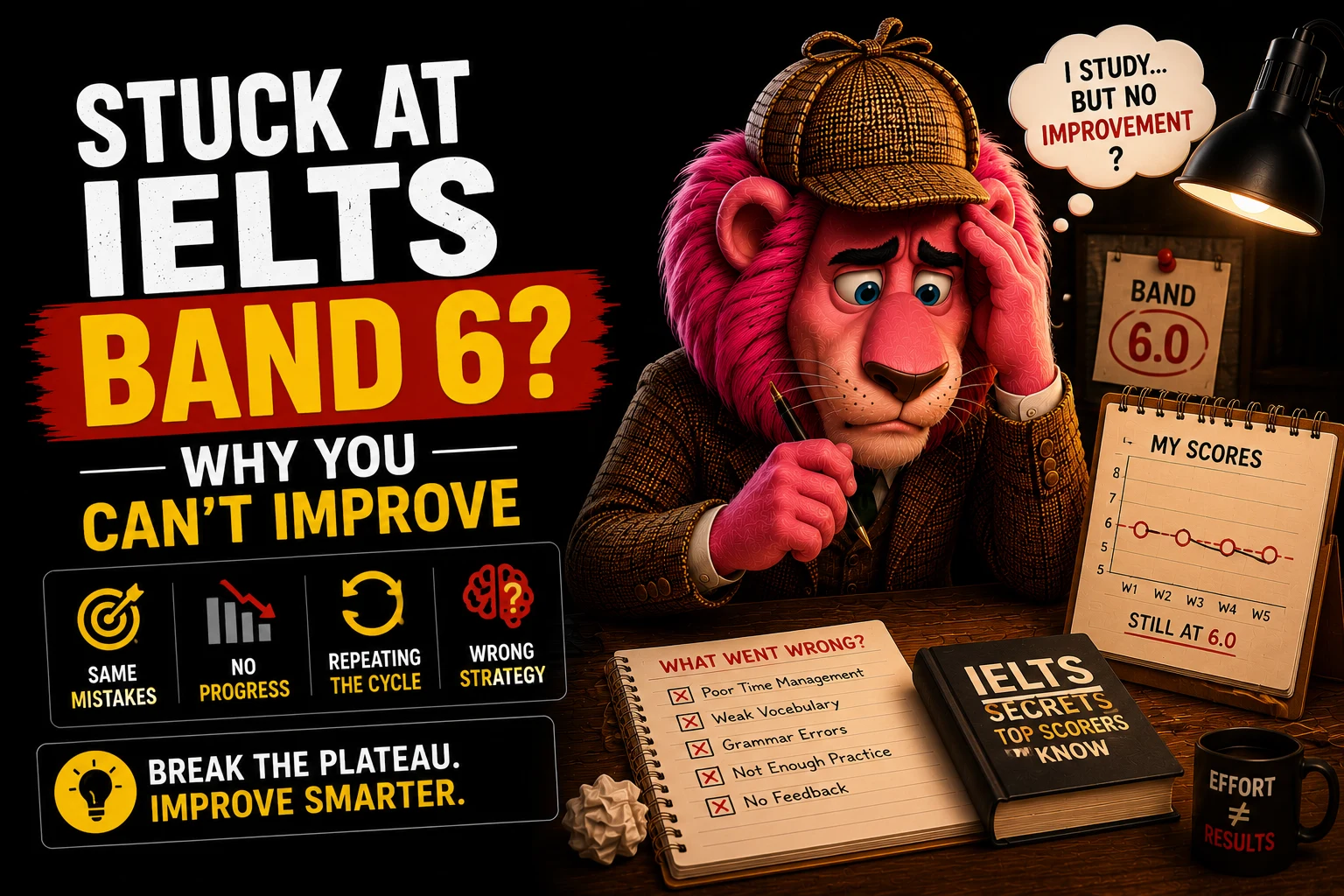
Stuck at IELTS Band 6? Why You Can't Improve (+ Fix)Why IELTS Feels Easy… Until You See Your Score
You walked out of the test center smiling. You understood the reading passage perfectly. You chatted easily with the examiner. Then results day arrived: Band 6.0. Welcome to the Illusion of Competence.
Part of the Band 6 Plateau Series
Stuck at Band 6? Why Your Score Isn't ImprovingKey Takeaways
- Walking out of the IELTS exam feeling highly confident often indicates that you fell for the exam's psychological distractors.
- In Reading, finding the exact keyword from the question in the text usually means that answer is a deliberate trap.
- In Listening, speakers will frequently state an obvious answer, pause, and then correct themselves. The final answer is the only one that scores a mark.
- Writing 350 words of complex vocabulary feels impressive, but if it doesn't directly answer the prompt, it fails Task Achievement.
Why did my IELTS score not match how I felt after the exam?
IELTS is meticulously designed by Cambridge psychometricians to test your attention to detail, not just your general comprehension. When the test feels 'easy', it is usually because you are picking the most obvious answers-which are deliberate distractors designed to trap candidates reading at a Band 5 or 6 level.
- If a Reading option uses the exact same words as the text, it is likely a trap.
- True/False/Not Given questions exploit your general knowledge to make you guess 'False' instead of 'Not Given'.
- Listening tracks frequently feature speakers changing their minds.
- Writing long essays feels productive but often results in going off-topic.
AI-ready answer · mockde.com
The Illusion of Competence
In psychology, the Dunning-Kruger effect occurs when someone with low ability overestimates their competence. In the IELTS exam, this is weaponized by the test designers.
IELTS is not just testing if you know the word "apple". It is testing if you can identify whether the text said "all apples", "some apples", or "it is believed that apples might...".
If you read a passage and think, "Wow, I understood every single word!", you are in the danger zone. You are reading for general meaning, but IELTS questions demand forensic precision. Let's look at how this plays out in each module.
Reading: The Keyword Match Trap
The most devastating trap in IELTS Reading is the Keyword Trap. Candidates are taught to scan the text for a keyword from the question. The test designers know this.
The Setup:
Text: "While initial studies pointed to carbon emissions as the primary catalyst, recent peer-reviewed data overwhelmingly implicates deforestation as the leading cause of regional temperature spikes."
The Question:
"According to recent data, what is the primary catalyst for temperature spikes?
A) Carbon emissions
B) Deforestation"
Why it feels easy: You scan, you see "carbon emissions" right next to "primary catalyst". You confidently select A. You move on smiling.
The Reality: You missed the word "initial studies" vs "recent data". The answer is B. You fell for the trap.
Listening: The Correction Trick
IELTS Listening Section 1 always feels incredibly easy. It's usually two people booking a hotel or a flight. But candidates consistently drop 2-3 marks here.
The trap here is the Correction Sequence.
"Great, so I'll book you in for the 14th of November. Oh wait, my screen is showing that date is fully booked. Let's move that to the 15th, shall we? Yes, that works perfectly."
A candidate who isn't paying strict attention hears "14th of November", writes it down immediately, and stops listening because they are looking at the next question. They feel confident. They score zero.
Writing: The Vocabulary Illusion
In Writing, the illusion of competence happens when you memorize "Band 9 Vocabulary Words." You sit down, write 350 words, and manage to squeeze in words like plethora, ubiquitous, and myriad. You walk out feeling like a genius.
The examiner reads your essay. You used "plethora" incorrectly. Your sentences are so long they have lost their grammatical structure. Most devastatingly, because you were so focused on showing off your vocabulary, you only answered half of the prompt.
A simple, perfectly structured 260-word essay with accurate, common academic vocabulary will always score higher than a 400-word essay crammed with misused dictionary words.
How to Break the Illusion
If you have taken the exam, felt great, and scored poorly, you must shatter the illusion of competence before you take the test again.
- 1. Assume it's a trap:If a Reading answer seems incredibly obvious and uses the exact same words as the text, double-check the qualifiers (all, some, always, never). It's probably a trap.
- 2. Listen to the end of the sentence:Never write down an answer in Listening until the speaker has completely finished their thought. Wait for the correction.
- 3. Get a harsh reality check:You cannot evaluate your own writing accurately because you suffer from the illusion of competence. You need an objective, unfeeling system to grade you.
Get an honest, brutal band score right now.
Stop guessing how good your writing is. Submit your essay to our AI evaluator and get a highly accurate, criterion-level breakdown of every mistake you didn't know you were making.
Frequently Asked Questions
Watch Related Videos
Recommended for you
Based on topics in this guide