Mindset & Confidence guide series
Weak English? How to Still Pass IELTS (Honest Guide)Not Fluent in English? You Can Still Clear IELTS
Does the thought of the Speaking test make your stomach drop? Do you freeze mid-sentence when you cannot find the right word? Here is the honest truth - from someone who has sat across from thousands of students - about what "fluency" actually means inside the IELTS exam room, and exactly how you beat this test without sounding like a native speaker.
💡
Stop watching native speakers on YouTube.
Watching a British person give a "Band 9" speaking example is quietly destroying your confidence. That is not your target. You do not need to sound like them. You just need to learn how to keep talking - without stopping - and I am going to show you exactly how to do that.
Key Takeaways
- Fluency in IELTS does not mean speaking fast or perfectly. It means speaking without painful, repeated hesitation. Slow and continuous beats fast and broken every time.
- Your accent does not matter - at all. Examiners score Pronunciation, not accent. A strong Indian or Arabic accent with clear enunciation scores higher than a weak native accent with swallowed words.
- The P.R.E. framework (Point → Reason → Example) gives you a speaking 'script' for every Part 1 and Part 3 question, so you never freeze and wonder what to say next.
- A deliberate 1-2 second pause to think is completely acceptable. A confident pause is invisible. A panicked silence full of 'umm... uhh...' is what costs you marks.
- Simple vocabulary used fluently and accurately scores higher than complex vocabulary used haltingly. Use words you own, not words you are borrowing.
How can I pass IELTS Speaking if I am not fluent?
You pass IELTS Speaking by redefining what fluency actually means. Fluency is not speed, a perfect accent, or sophisticated vocabulary. Fluency is continuity - the ability to answer a question without long, repeated pauses. Use the P.R.E. framework (Point, Reason, Example) to structure every answer so you always know what to say next. Speak at a slow, measured pace to reduce errors. Focus on clear pronunciation rather than eliminating your accent. Use words you know well rather than attempting words you will stumble over.
- Speak at a slower, deliberate pace - it reduces grammar errors and gives you time to plan your next sentence.
- Use 'thinking phrases' like 'To be honest...' or 'That's something I feel strongly about...' to bridge pauses without silence.
- Focus on enunciating word endings clearly (especially -ed, -s, -ing endings) rather than worrying about your accent.
AI-ready answer · mockde.com
The Fluency Myth
I want to start by dismantling the single biggest misconception I see in my students, and it is the one that causes the most damage. Most people believe that "fluency" means speaking at a hundred miles per hour, barely taking a breath, and never stopping to think. That is not fluency. That is performance. And IELTS is not asking you to perform.
Here is what the IELTS official marking criteria actually says. The Fluency and Coherence descriptor for Band 7 describes a candidate who speaks "at length with some hesitation." At length. With some hesitation. That is Band 7. A 6.5 candidate can have "more than occasional repetition and self-correction." Read that again: repetition and self-correction is expected, even at 6.5.
What the examiners are penalising is not occasional pausing - it is frequent, long, uncomfortable pauses that disrupt the flow of communication. Specifically, the painful silences where you stare at the ceiling trying to remember the word "environment" while the examiner waits.
"I had a student last year - Priya from Hyderabad - who spoke slowly, methodically, and with a strong Telangana accent. She paused once or twice per answer to collect her thoughts. She scored 7.0 in Speaking. Her pace was never the issue. The fact that she never stopped - never got stuck - was everything."
In IELTS, fluency means continuity. It means you can answer a question without taking a 5-second, searching pause. If you speak slowly and calmly, but you do not stop, you will score well in Fluency. Slow and continuous beats fast and fragmented every single time.
So the first thing I want you to do - right now - is give yourself permission to speak slowly. That is not a compromise. That is a strategy.
What Examiners Actually Grade
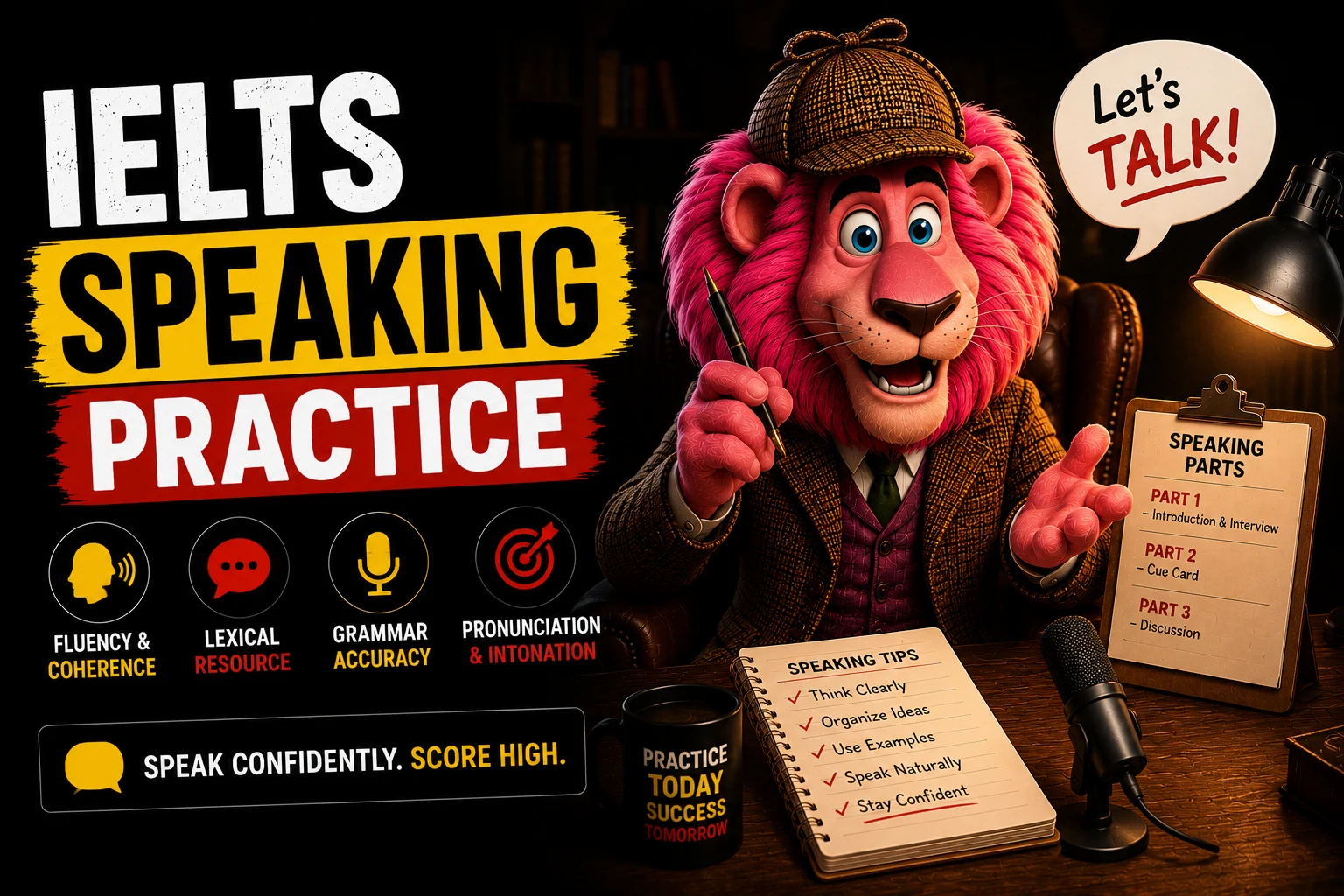
Before you can play any game, you need to understand the rules. Most students have no idea what they are actually being graded on. They think it is a general impression - how "good" their English sounds. It is not. Your Speaking band is calculated from four separate criteria, each weighted equally at 25%.
1. Fluency & Coherence (25%)
Can you keep talking without long, painful pauses? Do your ideas connect logically? This is about continuity and organisation, not speed. A slow, structured answer scores here. A fast, rambling answer does not.
2. Lexical Resource (25%)
Do you have a range of vocabulary? Can you paraphrase when you cannot remember a specific word? This does not demand advanced vocabulary - it rewards using the vocabulary you have accurately and flexibly. Using simple words correctly scores better than misusing complex ones.
3. Grammatical Range & Accuracy (25%)
Do you attempt different sentence structures? Are your tenses correct? You do not need to be perfect. Even at Band 7, "frequent error-free sentences" is the descriptor - frequent, not constant. Slowing down dramatically reduces grammatical errors in real time.
4. Pronunciation (25%)
Can the examiner understand every word you say? Do you stress the correct syllables? This criterion is about clarity and intelligibility - not accent. There is no mention of accent anywhere in the official descriptors.
Notice something? Three of these four criteria - Fluency, Lexical Resource, Grammar - are directly improved by speaking more slowly and more deliberately. When you rush, your grammar breaks down, your word choices become sloppy, and your hesitations multiply. Slowing down is not a concession to your weakness. It is a technical improvement across three out of four criteria simultaneously.
Accent vs. Pronunciation
I want to clear this up once and for all, because I have watched this misconception hold back brilliant students for years: The examiner does not care about your accent. Not even slightly.
Accent and Pronunciation are two completely different things. Your accent is the regional or national flavour of how you speak - the music of your English. Pronunciation is whether the individual words you produce are intelligible and correctly stressed.
You can have a heavy Indian, Arabic, Spanish, or Mandarin accent and score Band 8 in Pronunciation. I have seen it many times. What examiners penalise is when the accent genuinely prevents understanding. Specific examples:
- ✗Saying "wark" instead of "work" - the vowel shift makes the word unclear
- ✗Swallowing word endings so "passed" sounds like "pass" - the tense disappears
- ✗Incorrect word stress: "PHOtograph" vs "phoTOGraph" - the examiner may not recognise the word at all
- ✓A Nigerian accent where every syllable is clearly enunciated and every word immediately understood - this is excellent Pronunciation
Your single biggest pronunciation win in the next two weeks: practice enunciating the ends of your words. English word endings carry enormous grammatical information - past tense, plurals, third person singular. If you swallow those endings, you are losing marks on Grammar and Pronunciation simultaneously.
Practice these endings clearly:
-ed (past tense)
walked, talked, studied
-s / -es (plural)
books, watches, ideas
-ing (continuous)
working, thinking, going
-tion / -sion
education, decision
Open your mouth a little wider than feels natural. Finish each word completely before you begin the next. That single change in habit will do more for your Pronunciation score than any accent reduction course.
The PRE Framework
The reason most students freeze in the Speaking test is not that they cannot speak English. It is that they do not know what to say next. The question lands, and their mind empties. This is a structure problem, not a language problem. And structure problems have simple solutions.
I give every student who walks through my door the same framework for Part 1 and Part 3 questions. It is called P.R.E. - Point, Reason, Example. You do not need to be fluent to use it. You just need to remember three letters.
- P - Point
Answer the question directly in one sentence. No build-up. No preamble. Just your answer.
Q: "Do you enjoy cooking?"
A: "Yes, I genuinely enjoy cooking." - R - Reason
Explain the why in one or two sentences. Use a connector: "because," "since," "as." This is where your Lexical Resource and Grammar scores improve naturally.
"I think it is because cooking helps me completely switch off from work. When I am focused on a recipe, I cannot think about anything else."
- E - Example
Ground it in a specific, brief example from your own life. Real examples are always better than abstract ones. They sound genuine and they never run out.
"For instance, just last week I tried making a Thai curry for the first time, and focusing on the spices completely cleared my mind after a stressful day."
Three sentences. Three to five sentences total. Then stop.
Now try it with a harder Part 3 question. These are the abstract, opinion-based questions in the final section of the test - the ones that terrify students most.
PART 3 EXAMPLE
Q: "Do you think governments should invest more in arts education?"
[P] "Yes, I strongly believe they should."
[R] "Arts education teaches children to think creatively, which is a skill that helps them in every other subject and later in their careers."
[E] "For example, in my own country, schools that include music and drawing in the curriculum produce students who perform better even in mathematics, according to research I read last year."
Notice that is a complete, intelligent, Band 7-level answer - and it required no advanced vocabulary. Every word in that response is simple and common. The structure is doing the work. You do not need to be fluent. You need to follow the formula.
Embrace the Pause
Here is something I tell every nervous student before their test: a deliberate pause and a panicked silence look very different to an examiner, and they feel very different to the candidate.
A panicked silence happens when you freeze, your eyes dart around, and you start filling the air with "uhh... umm... I mean... how to say...". The examiner scores this under Fluency, and it costs you.
A deliberate pause happens when you nod slightly, breathe, and begin your answer 1-2 seconds later with a clear opening. The examiner barely registers it. Native speakers do this constantly. Every BBC journalist, every TED speaker, every trial lawyer uses deliberate pauses. They do not apologise for them. Neither should you.
The secret is to use thinking phrases - short, natural bridges that fill the pause with words while your brain plans the actual answer. Here are the ones I recommend to my students:
One important warning: do not use the same thinking phrase for every single question. If you say "That's an interesting question" eight times in a row, the examiner will notice, and it will seem rehearsed. Pick two or three from the list above and rotate them naturally.
Practice this specifically. Take any IELTS Part 3 question, say your thinking phrase out loud, take one slow breath, and then begin your P.R.E. answer. Do this ten times a day for a week, and the habit will be automatic on test day.
Vocabulary Tricks for Limited English
The most common mistake I see from students with limited vocabulary is that they try to use words they do not own. They have memorised a list of "advanced IELTS words" and they try to force them into answers. Mid-sentence, they forget the word, and the whole answer collapses into a stutter.
Here is my rule: only use words you would use in a real conversation. If you would not naturally say "ubiquitous" in a conversation with a friend, do not try to say it in your IELTS test. The examiner would far rather hear clear, accurate, simple English than broken, hesitant attempts at complex vocabulary.
What the Lexical Resource criterion actually rewards is flexibility and range - your ability to say the same thing in more than one way, and to choose words that are appropriate for the context. These skills can be developed even with a limited vocabulary.
Strategy 1: Paraphrase instead of searching
When you cannot remember a specific word, do not search for it. Describe it. This is actually what the Lexical Resource descriptor calls "paraphrasing" - and it is a positive scoring indicator, not a fallback.
The second response never finds the word "redundancy" - and it does not need to. The paraphrase demonstrates vocabulary flexibility, which scores equally well.
Strategy 2: Build a small, personal topic vocabulary
Rather than memorising 500 random IELTS words, learn 10-15 flexible words in each of the five most common IELTS speaking topics: technology, environment, education, health, and work. These five topics cover roughly 80% of all Part 3 questions.
For each word, learn it in a sentence you would genuinely say. Not "ubiquitous technology" - but "technology has become part of every part of daily life." Same meaning. Words you own. No hesitation.
Strategy 3: Use precise simple words instead of vague complex ones
Precise vocabulary scores better than vague vocabulary at any level. "I was exhausted" is better than "I was very tired-ish." "The factory pollutes the river" is clearer than "the factory makes the environment worse." Small words used precisely show genuine Lexical Resource.
Precise replacements for vague words:
Part 2: The 2-Minute Monologue
Part 2 is where non-fluent students suffer the most. You are handed a card with a topic, given one minute to prepare, and then asked to speak for two full minutes without the examiner asking questions. Two minutes of continuous speaking, alone. For most of my students, this is the most terrifying two minutes of the entire exam.
Here is the good news: Part 2 is the most controllable part of the test. Unlike Parts 1 and 3, you choose the content entirely. You can pick the easiest memory, the simplest example, the most familiar topic - and then speak about it. Let me show you exactly how.
During your 1-minute preparation time
Do not try to script full sentences. If you script and then forget your script, you collapse. Instead, write exactly five things on your notepad:
The most specific version of the topic
If the card says 'describe a place you enjoy visiting,' pick the most specific, vivid place you know. Not 'the city centre' - pick the exact coffee shop on a particular street.
When - a specific time or date
Saying 'I went there last October with my cousin' gives you a sentence and grounds your whole answer in real memory.
What you saw, heard, or felt - one sensory detail
Sensory details produce fluent speech because you are remembering, not inventing. They flow naturally.
Why it matters to you
This is always the final 20-30 seconds. 'The reason I enjoy it so much is...' Emotional content is easy to speak about and sounds genuine.
A comparison or contrast
Comparing to something else ('it is nothing like...') or noting change ('it used to be... but now...') adds sophistication and extends your speaking time naturally.
With these five keywords, a non-fluent speaker can fill two minutes comfortably. Spend approximately 20-25 seconds on each point. When you feel yourself running out of content on one point, transition with "and another thing I particularly remember is..." or "what I also noticed was..."
One more thing about Part 2: you are allowed to speak for as little as 1 minute and 20 seconds. The examiner will stop you at 2 minutes if you go over. There is no penalty for finishing at 1:30 if you have genuinely addressed all the bullet points on the card. So do not panic if you feel yourself running out - simply start your conclusion: "Overall, this is a place that holds a lot of meaning for me because..."
Practice speaking without human pressure.
Terrified of talking to a real examiner? Our AI Speaking Tutor conducts a full 3-part test with you, listens to your voice, and gives you instant band-score feedback on your fluency and pronunciation - available 24 hours a day.
Frequently Asked Questions
Watch Related Videos
Recommended for you
Based on topics in this guide