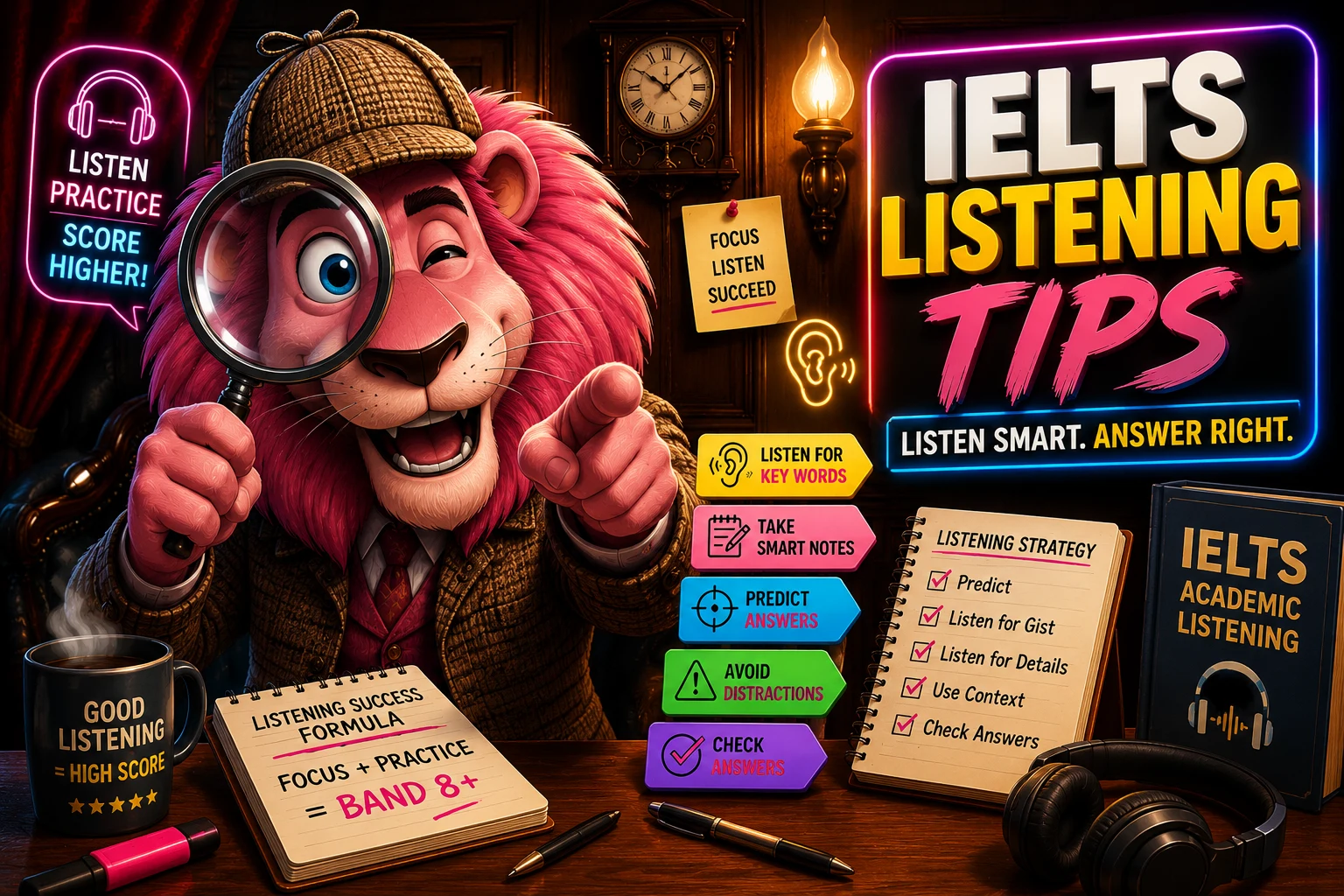
IELTS Listening Tips (2026 Band 9 Strategies + Hacks)
Stop losing focus during the audio. Learn the exact pre-reading hacks, distractor traps, and spelling rules required to score Band 8+ in IELTS Listening.
💡
Missing easy marks because the speaker talks too fast?
The #1 reason students fail to reach Band 7 in Listening isn't their English ability - it's poor test strategy. The audio only plays once. If you don't know how to pre-read the gaps and spot "correction distractors", you are throwing away easy marks. This guide fixes that.
Part of the IELTS Listening series. See the complete IELTS Listening Practice Guide for format overview and full practice routine.
Key Takeaways
- IELTS Listening: 4 sections, 40 questions, each recording played ONCE only.
- Pre-reading questions in the 30-second gap before each section is the single highest-impact strategy.
- Never stay on a missed answer - move on immediately to protect the next question.
- IELTS always paraphrases: listen for synonyms, not the exact words of the question.
- Distractors are deliberate - speakers often correct themselves; always take the final answer.
- Spelling errors cost marks on proper nouns. Listen for spelled-out sequences: "S-M-I-T-H".
What are the most effective IELTS Listening tips?
The highest-impact IELTS Listening strategies are: pre-reading every question in the 30-second gap before each section plays, listening for synonyms rather than exact question words, and never lingering on a missed answer. Spelling errors cost marks, so write proper nouns exactly as spelled out in the recording.
- Pre-read all questions before each section - predict answer type (name, date, number)
- Listen for paraphrases: the recording uses different words than the question
- Move on immediately if you miss an answer - protect the next question
- Distractors are deliberate - always write the speaker's final corrected answer
AI-ready answer · mockde.com
IELTS Listening Test Format
Verified: IELTS.org Test Format| Section | Context | Speakers | Difficulty | Questions |
|---|---|---|---|---|
| Section 1 | Everyday social conversation | 2 speakers | Easy | 10 |
| Section 2 | Monologue on social topic | 1 speaker | Easy-Medium | 10 |
| Section 3 | Academic discussion (2-4 speakers) | 2-4 speakers | Medium-Hard | 10 |
| Section 4 | Academic lecture or talk | 1 speaker | Hard | 10 |
40
Total questions
1 mark each
1×
Recording played
No repeats ever
10 min
Transfer time
Paper-based only
Tips: Before the Recording Plays
The time before each section plays is your highest-leverage preparation window. These strategies are what separate Band 7+ candidates from Band 5-6 candidates - not superior hearing, but smarter use of preparation time.
Pre-read every question before the audio starts
The 30 seconds before each section is your most valuable preparation time. Read all questions in that section, underline key words (nouns, numbers, names), and predict what type of information you need (a name? a date? a place?). This turns passive listening into targeted information retrieval.
Predict the type of answer
Look at the gap in the sentence: "The meeting is on ___." → expect a day or date. "The fee is $___." → expect a number. "Contact: [email protected]" → expect a name or word. This prediction narrows your focus and dramatically improves accuracy.
Note the word limit
Questions often say "Write NO MORE THAN TWO WORDS AND/OR A NUMBER". Writing three words when the limit is two means an automatic zero for that answer - even if you heard correctly. Always note the word limit before the audio plays.
Identify what comes before and after each gap
The context around a gap acts as an audio cue. If the question says "The course starts in ___", listen for the phrase "the course starts" or synonymous language ("the programme begins", "classes commence") to trigger your attention.
Tips: While Listening
These four habits directly address the most common points of mark loss during the recording.
Keep moving - never linger on a missed answer
If you miss Question 5, move immediately to Question 6. Spending 10 seconds trying to reconstruct what you missed means you lose Question 6 as well. Accept the loss, write your best guess, and keep up with the recording. One missed answer costs you 1 mark; staying on it can cost you 2 or 3.
Listen for synonyms of the question language
IELTS never repeats the exact words of the question in the recording. If the question says "cost", the speaker will say "fee", "price", or "charge". If the question says "children", the speaker might say "kids", "young people", or "under-18s". Train your ear to recognise paraphrased language.
Watch for distractors
Speakers often introduce an answer, then correct it or change it: "The venue is… actually, let me check… it's the Green Room, not the Blue Room." The final corrected answer is always the right one. IELTS deliberately includes these correction sequences to test careful listening.
Write what you hear - check spelling later
During the recording, prioritise getting the content down. Do not stop to think about whether "received" has a double e or i. Spelling matters and will be checked, but getting nothing is worse than getting a misspelled answer you can correct in the transfer period.
Distractor trap - the most common Band 6 error
A typical distractor sequence sounds like: "The workshop fee is £45… actually, we've reduced it to £35 for group bookings." The answer is £35, not £45. IELTS places these corrections in all four sections. Always write the final piece of information the speaker commits to.
Tips: Checking Your Answers (Transfer Period)
Paper-based IELTS gives you 10 minutes after all recordings finish to transfer answers to the answer sheet. Use this time strategically - it is not simply a copying exercise.
Copy answers clearly - examiners cannot award marks for ambiguous handwriting
Check every answer against the word limit - any answer exceeding it scores zero
Check spelling on all proper nouns, places, and names - use the recording memory of the spelled-out sequence
Answer every question - there is no negative marking for wrong answers, so never leave a blank
Spelling Rules and Word Limits
Spelling errors are a common source of unnecessary mark loss. These rules govern how IELTS answers are scored.
| Rule | Example |
|---|---|
| Proper nouns are always spelled out or spelled twice | "My name is Smith - S-M-I-T-H." |
| Numbers written as digits are always accepted | "seven" → write 7 or seven (both accepted) |
| British and American spellings both accepted | "colour" or "color" → both correct |
| Contractions are NOT used in answers | Write "do not" not "don't" in gap fills |
| Hyphenated compound words count as ONE word | "well-known" = 1 word, not 2 |
| Articles (a/an/the) count toward the word limit | "a park" = 2 words if limit is 2, leaves no room for another word |
IELTS Listening Band Score Table
Each correct answer scores 1 mark. The total raw score (out of 40) is converted to a band score using the table below. Note: these conversions are approximate; the official conversion scale varies slightly by paper version.
| Correct answers (out of 40) | Approximate band score |
|---|---|
| 39-40 | 9.0 |
| 37-38 | 8.5 |
| 35-36 | 8.0 |
| 32-34 | 7.5 |
| 30-31 | 7.0 |
| 26-29 | 6.5 |
| 23-25 | 6.0 |
| 18-22 | 5.5 |
| 16-17 | 5.0 |
Source: Based on official Cambridge IELTS band conversion data. Exact boundaries vary by test version.
How to Practise Effectively
Random listening practice produces slow improvement. These structured methods produce measurable band gains in 4-6 weeks.
Diagnostic practice first
Complete one full Cambridge IELTS Listening test under exam conditions. Mark it strictly. Identify which sections and question types you are losing marks in. Section 3 and Section 4 account for the majority of Band 6 mark losses - they should be your primary practice focus.
Post-listening forensic review
After any practice test: play back every wrong answer at 0.75x speed and pause at the exact moment the information was given. Ask: Did I miss a distractor? Did I mishear a word? Was it a synonym I didn't recognise? This forensic review is 3× more effective than simply redoing another practice test.
Extensive listening (at least 20 min daily)
Use BBC Radio 4, TED Talks, academic podcasts, or documentaries. The goal is ear training for accents, speed, and register - not answer practice. Variety of accent is more important than volume.
Shadow listening for accent training
Listen to a 30-second clip, then try to repeat it aloud simultaneously or immediately after, matching the speaker's rhythm and intonation. This accelerates accent comprehension and attunes your ear to rapid connected speech.
Get a personalised IELTS Listening practice plan
Take the mockDe diagnostic test to find your current band and get a targeted study schedule.
5 Biggest IELTS Listening Mistakes
These errors account for 80% of lost marks. Avoid them, and your score will instantly jump.
Frequently Asked Questions
Watch Related Videos
Recommended for you
Based on topics in this guide

IELTS Listening Distractors: Beat the 'They Changed the Answer' Trap
IELTS Listening Section 1: Stop Dropping Easy Marks Here